
Explanation of ETP or EC principles and procedures
Electrolysis-based ETP (Effluent Treatment Plant) or Electrocoagulation (EC) is an advanced and eco-friendly technology for industrial wastewater purification. In this technique, a specific direct electrical current (DC) is applied through metallic electrodes submerged in contaminated effluent. Consequently, concurrent electrochemical reactions facilitate Coagulation, Flotation, and Redox (reduction-oxidation) processes, thereby removing organic contaminants, inorganic heavy metals, synthetic polymers, and pathogenic microorganisms (viruses and bacteria) from the wastewater.
In this process, iron (Fe) or aluminum (Al) plates are installed as sacrificial anodes (Sacrificial Anode).
(a) Anode Reaction (Metal Oxidation): Under direct electrical current, the sacrificial anode dissolves to liberate active multivalent metal cations into the aqueous solution:
(b) Cathode Reaction (Water Reduction): Water is reduced at the cathode, generating hydroxyl ions (OH−) and fine hydrogen gas bubbles (H2):
(c) Formation of Metal Hydroxide or Floc: The electrochemically generated metal cations combine with the hydroxyl ions to form gelatinous, insoluble metal hydroxides known as Floc:
Hazardous heavy metal ions present in industrial effluent (Cr6+, Pb2+, Cd2+, Cu2+, etc.) participate in redox reactions with the sacrificial metal species or form insoluble coordination complexes with the metal hydroxides, settling down as insoluble sludge precipitates.
Industrial textile dyes, surfactants, and colloidal synthetic polymers generally carry negative surface charges in wastewater. The positively charged polyvalent cations (Al3+ or Fe3+) released from the anode neutralize these repulsive surface charges. Consequently, the electrostatic repulsion among polymer chains and organic particles is eliminated, causing them to aggregate and agglomerate into dense flocs (Flocculation).
- 1. Direct Membrane Lysis: The high-intensity localized electric field induces membrane disruption (Electroporation), directly lysing and inactivating harmful bacteria and viruses.
- 2. Generation of In-situ Disinfectants: Naturally present chloride ions (Cl−) are oxidized at the anode into chlorine, which rapidly hydrolyzes to form hypochlorite ions (OCl−). This serves as a potent in-situ oxidizing germicide, thoroughly disinfecting the water:
2Cl− → Cl2 + 2e− ; Cl2 + H2O → HOCl + HCl ; HOCl → H+ + OCl−
Micro-fine hydrogen gas bubbles (H2) evolving continuously from the cathode ascend through the water column, capturing and carrying suspended oils, grease, and low-density colloidal particles upward. They assemble into a floating surface foam layer (Scum), which is readily removed by automated mechanical skimmers.
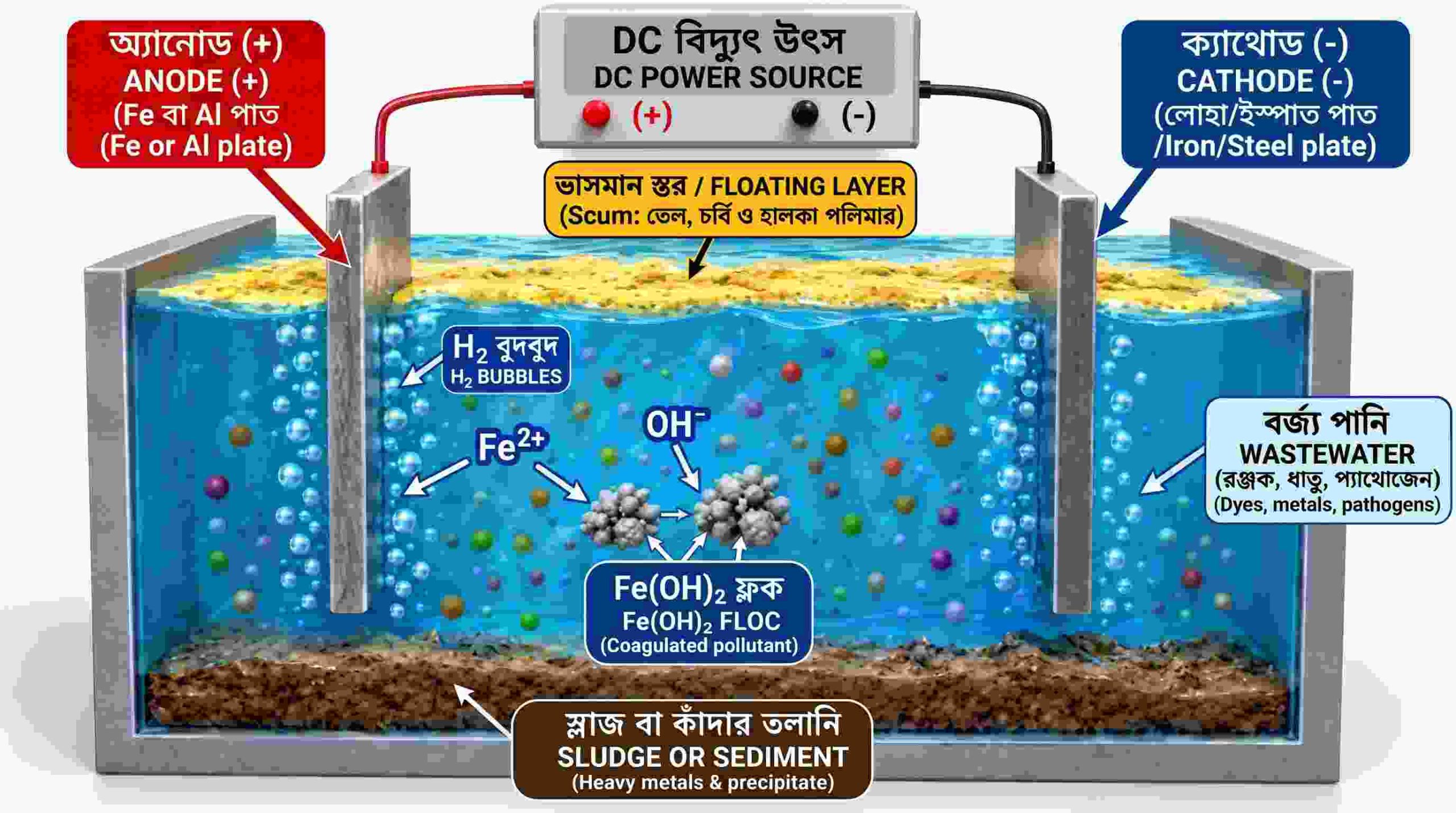 Figure: Internal Working Architecture and Reaction Mechanisms of an Advanced Electrocoagulation (EC) ETP Cell
