
Explain the working mechanism and principles of an ETP (Effluent Treatment Plant) in biotechnology.
The fundamental principle of a biotechnology-based ETP is to biologically decompose hazardous organic matter present in liquid industrial effluent into eco-friendly, purified water through an artificial food chain (Food Chain) with the aid of diverse microorganisms and detritivores.
Following primary treatment, the liquid effluent or sludge is channeled through filters into a biological processing unit, where the biological breakdown (Biodegradation) of organic compounds initiates.
The biodegraded liquid sludge is fed drop by drop into an artificially designed detritus vessel. This chamber contains diverse detritivores—such as bacteria, fungi, protozoa, worms, snails, and aquatic insects.
In the first tier of the food chain, bacteria and fungi consume the complex organic waste substances in the liquid sludge as their nutrients and break them down.
In the second trophic stage, protozoa feed on these bacteria and fungi, thereby maintaining the microbiological balance of the aquatic medium.
In the subsequent stage of the food chain, snails, worms, and small aquatic insects sustain themselves by feeding on the protozoa. Consequently, complex organic contaminants are thoroughly assimilated across the entire food chain, detoxifying the effluent.
- The effluent from the detritus chamber is then transferred into a settling tank (Settling Tank), where suspended sediments settle to the bottom and clear water rises to the surface.
- The settled sludge at the bottom is separated and routed to an anaerobic digester and drying beds.
- The upper clarified water is directed to a chlorination tank for disinfection. The action of chlorine completely destroys pathogenic (disease-causing) bacteria and protozoa.
The chlorinated, safe, and purified water is transferred via pipelines into a holding pond and subsequently discharged safely into natural rivers or the sea.
Because the dried sludge recovered from the drying beds is devoid of hazardous and toxic components, it serves as an excellent organic bio-fertilizer for agricultural farmland or for low-lying land reclamation.
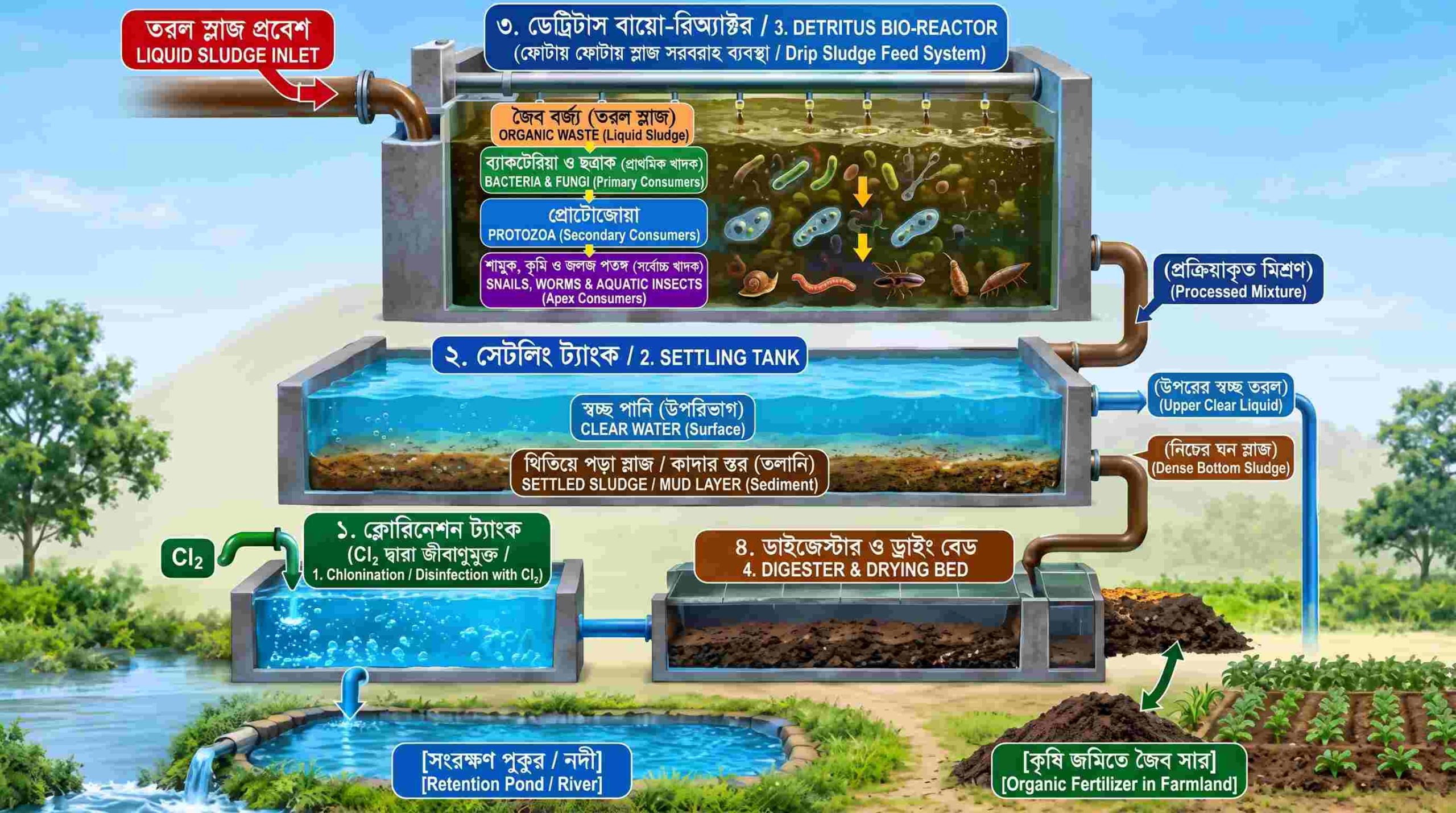 Figure: Biological ETP System (Microbial Degradation & Artificial Food Chain Operation)
