
Explain the working mechanism and principles of a Catalytic ETP (Effluent Treatment Plant).
The fundamental principle of Catalytic ETP or Catalytic Oxidation (Catalytic Oxidation) is to degrade complex, non-biodegradable, toxic organic compounds in industrial effluent into environmentally safe simple molecules (CO2, H2O) and harmless mineral salts by using powerful oxidizing agents (such as H2O2 or O3) in the presence of an appropriate catalyst (such as Fe2+, Fe3+, TiO2, or transition metal oxides).
In catalytic ETP, Fenton’s Process is most widely employed. In this method, ferrous sulfate (FeSO4 or Fe2+) is added as the catalyst and hydrogen peroxide (H2O2) as the oxidizing agent into the wastewater. Driven by catalytic action, ultra-reactive hydroxyl free radicals (•OH) are instantaneously generated:
(In heterogeneous photocatalysis, UV irradiation on a TiO2 catalyst generates identical high-energy oxidative radicals.)
The generated hydroxyl free radicals (•OH) operate as exceptionally potent, non-selective oxidizing agents. They attack and cleave the stable carbon-carbon bonds of textile dyes, surfactants, phenolic compounds, pesticides, and complex synthetic polymers. Consequently, the recalcitrant organic contaminants are completely mineralized into harmless final products:
Owing to their extreme oxidation potential, the free radicals rapidly oxidize and rupture the cellular membranes of disease-causing bacteria and denature viral protein coats, rendering the water completely disinfected and sterile.
Upon completion of the oxidation reactions, an alkaline agent (such as slaked lime or NaOH) is introduced to raise the effluent pH to 7–8. At this neutral-to-mildly alkaline pH, the ferric ions (Fe3+) produced during the first step precipitate as insoluble ferric hydroxide [Fe(OH)3]:
This bulky gelatinous precipitate acts as an efficient coagulant, enmeshing and sweeping down any remaining suspended micro-particles and colloids to settle as dense sludge at the bottom of the clarifier.
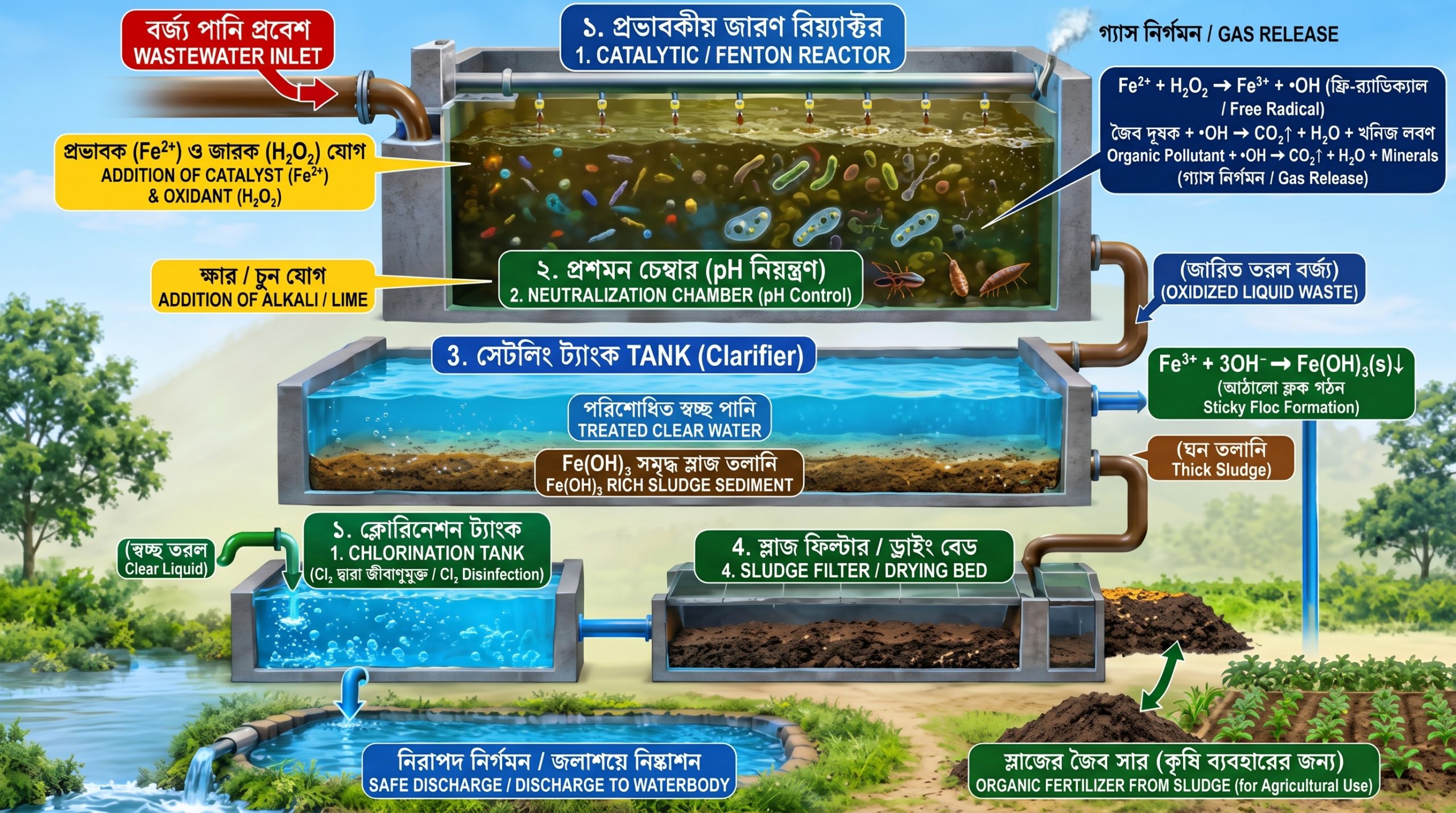 Figure: Working Principle and Reaction Mechanism of a Catalytic ETP (Fenton Advanced Oxidation Process)
