
Definition and explanation of magnetic quantum numbers
Magnetic Quantum Number
The negatively charged electrons revolve around the positively charged nucleus, which creates an electric field inside the atom. Due to the influence of this electric field, a magnetic field is generated. Under the influence of this magnetic field, the three-dimensional orientation (spatial distribution) of the electron’s orbit takes place. The quantum number used to express these different types of spatial orientations is called the Magnetic Quantum Number.
Function:
It expresses the three-dimensional orientation or spatial distribution of orbitals.
Characteristics:
- The magnetic quantum number is denoted by m.
- The value of m depends on the value of l (Azimuthal quantum number).
- The total number of values for m will be (2l + 1), and the values range from -l through 0 to +l.
- Zeeman effect can be explained by this quantum number.
- This quantum number designates the orbitals and their three-dimensional direction.
- The total number of values of m indicates the total number of orbitals in a sub-shell.
- The division of a sub-shell into individual orbitals can be determined from the magnetic quantum number.
Examples:
- If l = 1, the total number of values for m will be (2l + 1) = 3, and the values are: -1, 0, +1
- If l = 2, the total number of values for m will be (2l + 1) = 5, and the values are: -2, -1, 0, +1, +2
- If l = 3, the total number of values for m will be (2l + 1) = 7, and the values are: -3, -2, -1, 0, +1, +2, +3
Let’s observe the following table:
| Sub-shell | Value of l | Values of m | Orbitals in Sub-shell | Number of Orbitals |
|---|---|---|---|---|
| s (Sharp) | 0 | 0 | s | 1 |
| p (Principal) | 1 | -1, 0, +1 | px, py, pz | 3 |
| d (Diffuse) | 2 | -2, -1, 0, +1, +2 | dxy, dyz, dzx, dx2-y2, dz2 | 5 |
| f (Fundamental) | 3 | -3, -2, -1, 0, +1, +2, +3 | fx(x2-y2), fy(x2-y2), fz(x2-y2), fz3, fxyz, fxz2, fyz2 | 7 |
When l = 0 (s subshell), then m = 0; therefore, there is only one orbital in the s subshell, i.e., the s orbital.
 Figure: Spherical shape and orientation of an s orbital
When l = 1 (p subshell), then m = -1, 0, +1; that is, m = -1 (px), 0 (py), +1 (pz). Therefore, only three orbitals are possible in the p subshell.
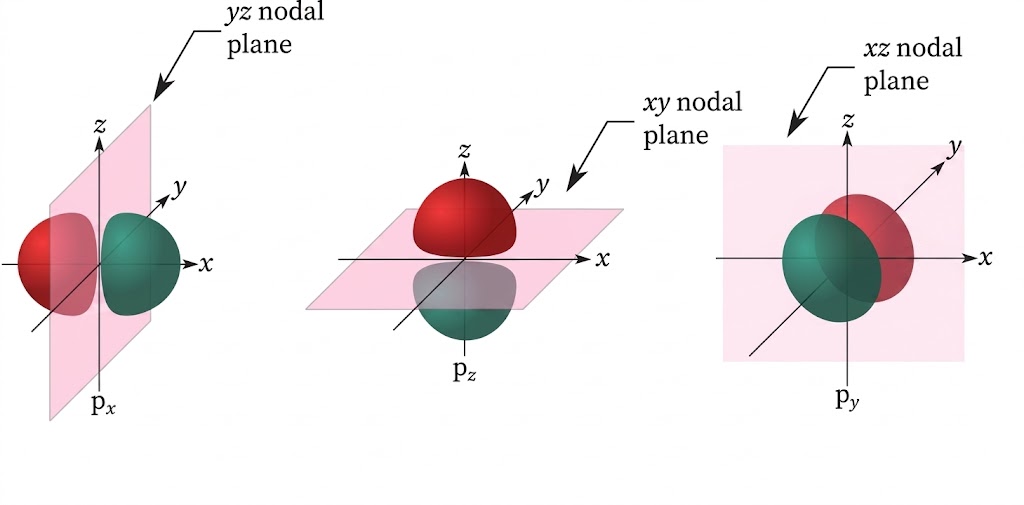 Figure: Dumbbell shapes and spatial orientations of px, py, and pz orbitals
When l = 2 (d subshell), then m = -2, -1, 0, +1, +2; that is, m = -2 (dxy), -1 (dyz), 0 (dzx), +1 (dx2-y2), +2 (dz2). Therefore, only five orbitals are possible in the d subshell.
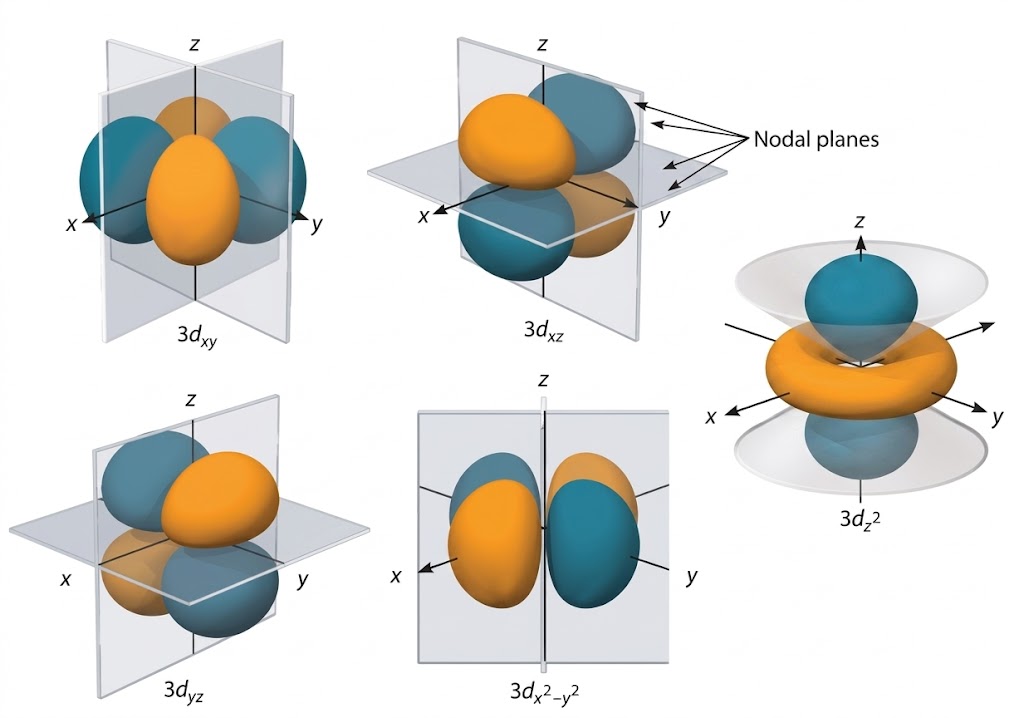 Figure: Double-dumbbell shapes and spatial orientations of the five d orbitals
