
Detailed explanation of Troposphere, Stratosphere, Mesosphere, Thermosphere
| Layer Name | Altitude (km) | Temperature Range (°C) | Main Components |
|---|---|---|---|
| Troposphere | 0 to 11 | 15 to -56 | N₂, O₂, CO₂, H₂O₍g₎ |
| Stratosphere | 11 to 50 | -56 to -2 | O₃ |
| Mesosphere | 50 to 85 | -2 to -92 | O₂⁺, NO⁺ |
| Thermosphere | 85 to 500 | -92 to 1200 | O₂⁺, O⁺, NO⁺ |
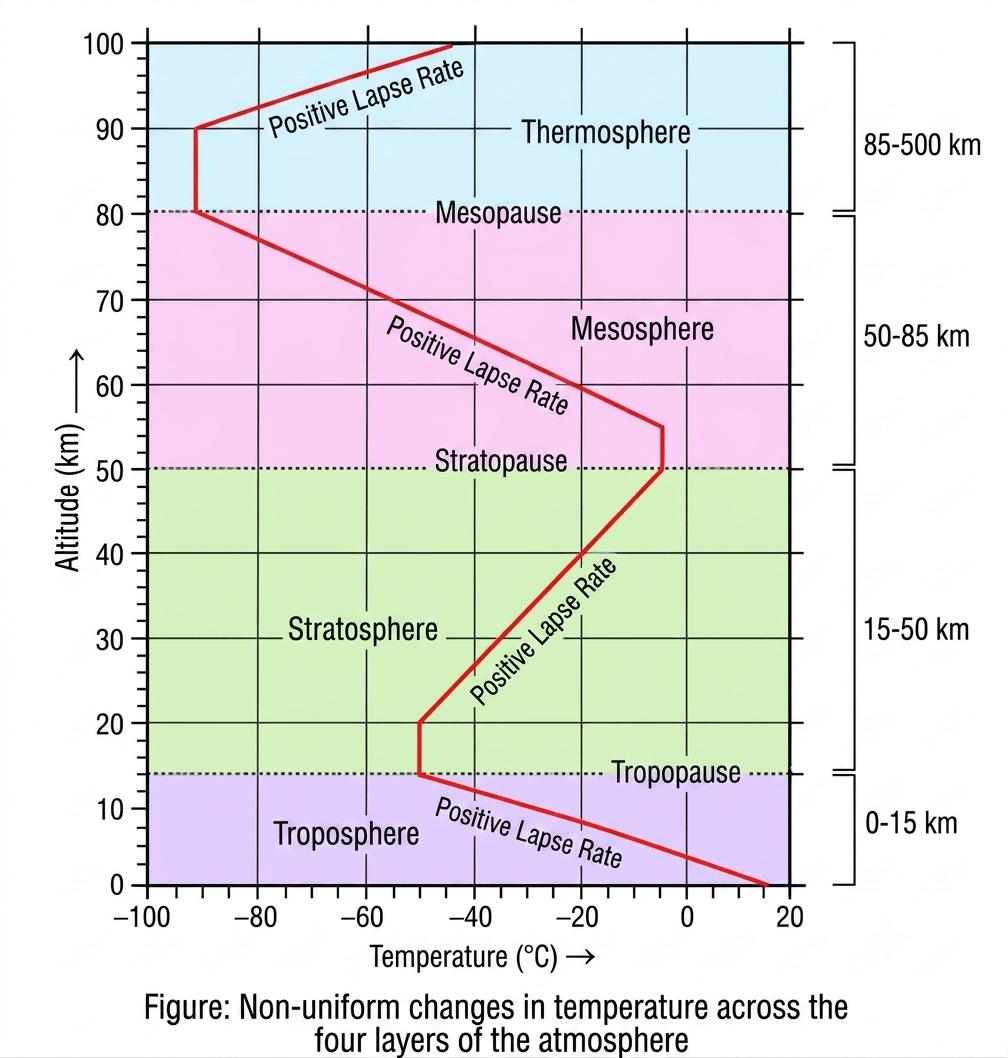
Figure: Atmospheric Layers
Introduction: The layer closest to the Earth’s surface is known as the Troposphere. It is the lowest layer of the atmosphere.
Key Characteristics:
- Higher concentration of water vapor is found in the lower part of this layer. Phenomena like clouds, rainfall, lightning, storms, dew, fog, and snowfall occur here. Therefore, the state of the troposphere controls the weather and climate of a place.
- Air density and temperature decrease as altitude increases from the surface. It extends from 0 to 11 km, with temperatures ranging from +15°C to -56°C and pressure from 200 mm(Hg) to 100 mm(Hg).
- Significant temperature inversions can occur in this region.
- Differences in heat and pressure in this layer generate wind flow.
- The air density is highest in this layer, and approximately 97% of the weather-forming components are present here.
- It gradually transitions into the Stratosphere; the boundary between these two layers is called the Tropopause.
Atmospheric Components (Troposphere):
| Component | Percentage (%) |
|---|---|
| Nitrogen (N₂) | 78.08 |
| Oxygen (O₂) | 20.94 |
| Water Vapor (H₂O) | 1-4 |
| Argon (Ar) | 0.93 |
| Carbon Dioxide (CO₂) | 0.03 |
| Neon (Ne) | 0.0018 |
| Helium (He) | 0.0005 |
| Methane (CH₄) | 0.00018 |
| Krypton (Kr) | 0.00011 |
| Nitrous Oxide (N₂O) | 0.0003 |
| Hydrogen (H₂) | 0.0005 |
| Ozone (O₃) | 0.000005 |
| Carbon Monoxide (CO) | 0.00001 |
| Iodine (I₂) | 0.000001 |
| Nitrogen Dioxide (NO₂) | 0.0000002 |
- 1. There is no water vapor in the Stratosphere region. Therefore, phenomena like clouds, rainfall, lightning, storms, dew, fog, and snowfall do not occur in this layer. It is a cloudless region, and due to the absence of weather disturbances, jet planes usually fly through this layer.
- 2. The extension or altitude of this layer is from 11 km to 50 km. The temperature in this region ranges from -56°C to -2°C, and air pressure ranges from 100 mm(Hg) to 1 mm(Hg).
- 3. A 3-5 km thick Ozone layer exists here, which prevents harmful ultraviolet rays from reaching the Earth’s surface. Ozone is the primary chemical component of this layer.
- 4. The temperature change in this layer is the exact opposite of the Troposphere (temperature increases as altitude increases).
- 5. Both air density and pressure are low in this layer.
- 6. The weather in this layer is dry and calm; hence, it is also known as the “Quiet Layer” or “Calm Sphere.”
- 7. The air in this layer is very light, and there are no significant differences in heat or pressure.
- 8. There is no vertical movement (upward or downward) of air in this layer, and wind flow is weak and parallel in nature.
- 9. The Stratosphere is considered the “Upper Sky.”
- 1. There are no solar radiation-absorbing chemical components in the Mesosphere region.
- 2. Air density in this layer is very low.
- 3. Temperature decreases with increasing altitude in this layer. It ranges from -2°C to -92°C, altitude spans 50–85 km, and air pressure ranges from 0.1 mm(Hg) to 0.0001 mm(Hg).
- 4. Because of this layer, meteors cannot strike the Earth’s surface.
- 5. The chemical components in this layer exist in an ionized state, such as O₂⁺ and NO⁺.
d) Thermosphere
The layer following the Mesosphere in the atmosphere is known as the Thermosphere. It is separated by a thin layer called the Mesopause. The boundary between the Thermosphere and the Mesosphere is called the Mesopause.
The lower part of the Thermosphere is the Ionosphere, while the upper part consists of the Exosphere and the Magnetosphere.
- 1. Air pressure and density in this layer are extremely low.
- 2. Water vapor concentration is considered abnormal in this layer.
- 3. Lightning discharges occur in this part of the atmosphere.
- 4. Meteors and cosmic particles are found in the upper regions of the Ionosphere.
- 5. The density of atomic oxygen is higher than that of molecular oxygen in this layer.
Due to the influence of ultraviolet and cosmic rays, Oxygen and Nitric Oxide become ionized, existing as O⁺ and NO⁺ respectively.
(a) Introduction: The portion above the Thermosphere is known as the Exosphere, and the layer above the Exosphere that encompasses Earth’s atmosphere is the Magnetosphere, a magnetic field region formed by protons and electrons.
Altitude and Extent: According to data from the National Aeronautics and Space Administration (NASA), the Magnetosphere extends from an altitude of 660 km to 10,000 km.
Temperature: In the Exosphere, temperature continues to rise with increasing altitude, ranging from 200°C to 1700°C.
- 1. Air density in this layer is extremely low.
- 2. Temperatures are very high due to solar radiation.
- 3. Lightning phenomena occur in this layer as well.
- 4. Meteors and cosmic particles are detected in the upper regions.
- 5. Atomic oxygen density is higher than molecular oxygen in the Exosphere layer.
- 6. Hydrogen and Helium are present as chemical elements in the Exosphere.
Atmospheric Structure Based on Composition of Gaseous Components
Based on the ratio of different gases from the Earth’s surface toward outer space, the atmosphere is divided into two main parts: a) Homosphere and b) Heterosphere.
This region extends from sea level up to approximately 85 km in altitude. The ratio of various gaseous components remains relatively uniform throughout this layer, which is why it is called the Homosphere. Everywhere in this layer, Nitrogen (78.08%) and Oxygen (20.94%) are present. Additionally, Argon, Neon, Krypton, Xenon, and Ozone are also present.
The Homosphere is divided into three unequal sub-layers based on temperature and altitude: Troposphere, Stratosphere, and Mesosphere.
The layer following the Homosphere is called the Heterosphere. This region extends from 85 km up to 10,000 km above sea level. In this layer, the proportion of gaseous components is not uniform, hence it is called the Heterosphere. Based on the variation in the amount of elemental substances, the Heterosphere is divided into four sub-layers:
- 1. Atomic Nitrogen layer: 85–200 km
- 2. Atomic Oxygen layer: 200 – 1100 km
- 3. Helium layer: 1100 – 3500 km
- 4. Hydrogen layer: 3500 – 10,000 km
Furthermore, based on ionization levels and other characteristics, the Heterosphere is divided into three sub-layers:
- 1. Ionosphere: 100-300 km (approx.)
- 2. Exosphere: 300-1,000 km (approx.)
- 3. Magnetosphere: 1,000 km to unspecified upper limit (approx.)
The Ionosphere can be further divided into various small rings, as these small layers have distinct capabilities for reflecting radio waves and creating polar effects (Aurora). Scientific research is ongoing regarding the Heterosphere. The natural advantage of this layer in reflecting radio waves is beginning to be utilized for human benefit. It is expected that detailed exploration will lead the Heterosphere to play an effective role in resource creation and utilization.
a) Knowledge-Based Questions & Answers
b) Comprehension-Based Questions & Answers
c) Multiple Choice Questions (MCQ)
