
La-Chatellier’s principle and the effect of various regulators on the equilibrium of reactions and Chatelier’s principle. Answers to all questions.
Le Chatelier’s Principle and the Effect of Various Factors on Chemical Equilibrium
Answer: If any factor (such as temperature, pressure, or concentration) determining the equilibrium state of a system is changed, the system will shift its equilibrium position in such a way as to counteract or nullify the effect of the change.
Effect of Temperature, Pressure, and Concentration on Chemical Equilibrium:
Effect of Temperature on Equilibrium Position:
To consider this effect, we can analyze two types of reactions—
a. Endothermic Reaction:
This reaction is an endothermic reaction, meaning heat is absorbed during this process. Therefore, if the temperature is increased, according to Le Chatelier’s principle, the equilibrium position will shift from left to right to counteract the increase in temperature. As a result, the dissociation rate of reactants A and B increases, thereby increasing the yield of products C and D. In other words, increasing the temperature drives the reaction forward, absorbing the heat and neutralizing the effect of the temperature rise.
On the other hand, if the temperature is decreased, according to Le Chatelier’s principle, the equilibrium position will shift from right to left to counteract the decrease in temperature. Consequently, the dissociation rate of C and D increases, enhancing the production of A and B. Thus, decreasing the temperature drives the reaction backward, releasing heat and neutralizing the effect of the temperature drop.
b. Exothermic Reaction:
This reaction is an exothermic reaction, meaning heat is released during this process. Therefore, if the temperature is increased, according to Le Chatelier’s principle, the equilibrium position will shift from right to left to counteract the temperature increase, causing the dissociation rate of C and D to increase and producing more A and B. That is, increasing the temperature drives the reaction backward, absorbing heat and nullifying the effect of the temperature rise.
Conversely, if the temperature is decreased, according to Le Chatelier’s principle, the equilibrium position will shift from left to right to neutralize the effect of the temperature drop, causing the dissociation rate of A and B to increase, which raises the production of C and D. Thus, decreasing the temperature drives the reaction forward, producing heat and neutralizing the effect of the temperature decrease.
Effect of Pressure on Equilibrium:
Pressure has no effect on liquid and solid substances. However, it significantly affects reactions that take place in the gaseous phase. When pressure is applied to a chemical reaction at equilibrium, Le Chatelier’s principle dictates that the equilibrium shifts in such a way as to minimize or counteract the applied pressure.
a. When the number of moles of reactants and products is equal:
In this gaseous reaction, the total number of moles of reactants (A and B) and products (C and D) are equal (i.e., 2 moles each). Therefore, the total volume of reactants and products remains the same. Because of this, pressure has no effect on this gaseous reaction.
b. When the number of moles of products is less than reactants:
1 mole of gas A and 1 mole of gas B (total 2 moles of reactants) produce 1 mole of gas C. This means the volume of the products is less than the volume of the reactants.
Therefore, if pressure is increased, according to Le Chatelier’s principle, the equilibrium shifts from left to right to counteract the increase in pressure by reducing the volume. In this case, the dissociation rate of A and B increases to yield more product C. In short, increasing pressure drives the reaction forward, reducing volume to neutralize the applied pressure.
Conversely, if pressure is decreased, the equilibrium shifts from right to left to increase the volume and counteract the pressure drop. Here, the dissociation of C increases to produce more A and B. Thus, decreasing pressure drives the reaction backward, increasing volume to neutralize the pressure drop.
c. When the number of moles of products is greater than reactants:
1 mole of reactant gas C produces 1 mole of A and 1 mole of B (total 2 moles of products). This means the volume of the products is greater than that of the reactant.
Therefore, increasing the pressure causes the equilibrium to shift from right to left to decrease the volume and counteract the pressure rise. Consequently, the dissociation of A and B increases to yield more C. Thus, increasing pressure drives the reaction backward, reducing volume to neutralize the applied pressure.
Again, decreasing the pressure causes the equilibrium to shift from left to right to increase the volume and counteract the pressure drop. Here, the dissociation of C increases to yield more A and B. Therefore, decreasing pressure drives the reaction forward, increasing volume to neutralize the pressure drop.
Effect of Concentration:
The effect of component concentrations on reversible reactions at equilibrium can be explained using Le Chatelier’s principle. For example: When AX5 is heated in a closed container, it reversibly dissociates to form AX3 and X2. For instance:
In this reaction, AX5 partially dissociates, and eventually, an equilibrium is established between undissociated AX5 and the generated AX3 and X2. All three components (AX5, AX3, and X2) are present in this equilibrium mixture.
If some amount of AX5 is added to this equilibrium mixture, the concentration of AX5 increases. An increase in the concentration of AX5 would theoretically increase the value of the equilibrium constant (Kc). However, at a constant temperature, the value of the equilibrium constant (Kc) does not change; therefore, the added AX5 dissociates to counteract the effect of the added AX5. As a result, the equilibrium shifts to the right.
On the other hand, if some amount of X2 is added to the equilibrium mixture, its concentration increases. Although an increase in X2 concentration suggests an increase in Kc, the equilibrium constant (Kc) remains constant at a fixed temperature. To counteract this change, the added X2 reacts with AX3 to increase the concentration of AX5, thereby nullifying the effect of the added X2. Consequently, the equilibrium shifts to the left.
Furthermore, if some amount of AX3 and X2 is removed from the reaction vessel, more PCl5 (or AX5) dissociates to fill the empty space and maintain equilibrium, producing more AX3 and X2. As a result, the equilibrium shifts to the right. Thus, it is observed that changing the concentration alters the position of equilibrium, but does not change the value of the equilibrium constant (Kc).
Use of Catalyst:
Catalysts are used to increase the reaction rate and reach equilibrium quickly. A catalyst has no effect on the position of equilibrium itself; it is simply used to speed up the reaction rate to attain equilibrium faster.
Describe the effect of temperature, pressure, and concentration on the following reactions:
- 1. H2(g) + N2(g) ⇌ 2NH3(g) + Heat
- 2. 2SO2(g) + O2(g) ⇌ 2SO3(g) + Heat
- 3. N2(g) + O2(g) ⇌ 2NO(g) – Heat
- 4. N2O4(g) ⇌ 2NO2(g) + Heat
- 5. 2N2O5(g) ⇌ 4NO2(g) + O2(g) + Heat
Question 2. Explain the effect of temperature on the equilibrium constant (Kp).
Answer: The effect of temperature on the equilibrium constant Kp can be explained with the help of the Van ‘t Hoff equation. The Van ‘t Hoff equation is—
Here,
ΔH = Change in enthalpy,
T = Absolute temperature, R = Universal gas constant
We know that for endothermic reactions, increasing the temperature increases the reaction rate, and as the reaction rate increases, the value of Kp also increases. Therefore, for an endothermic reaction, plotting log Kp along the y-axis against
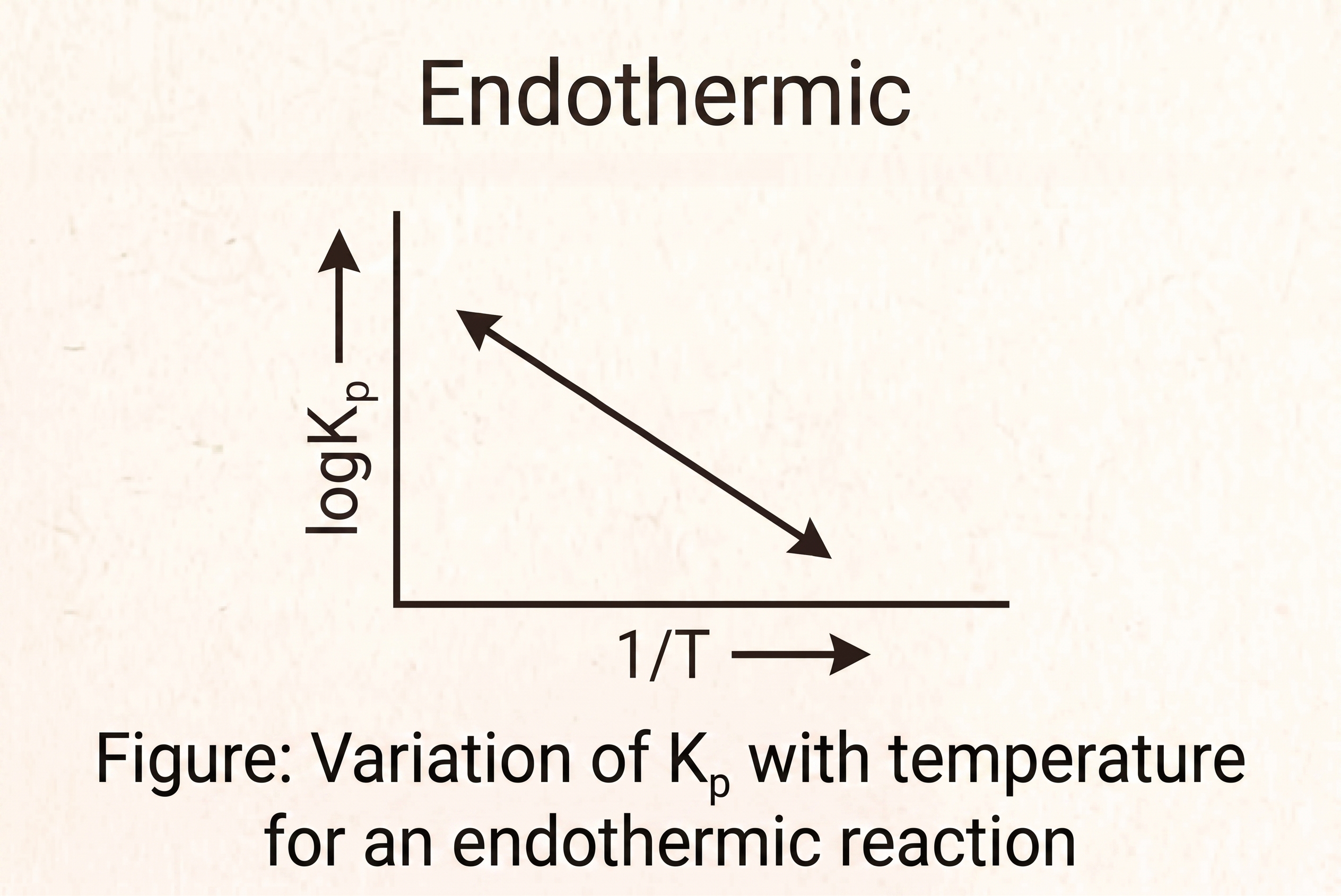
Figure: Variation of Kp with temperature for an endothermic reaction
On the other hand, for exothermic reactions, increasing the temperature decreases the reaction rate, and thus the value of Kp also decreases. Therefore, the graph in this case will be the opposite of that for an endothermic reaction.
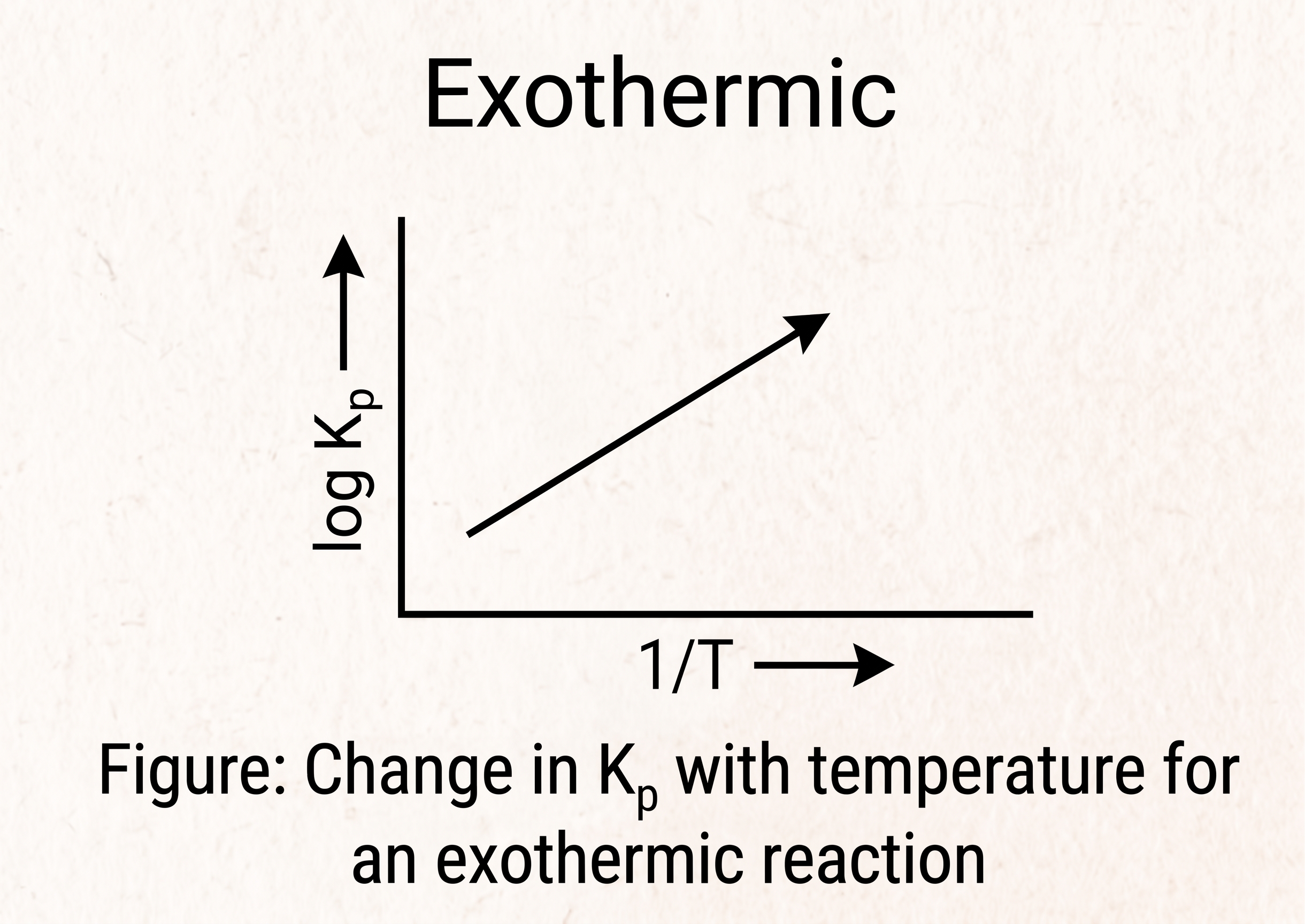
Figure: Variation of Kp with temperature for an exothermic reaction
Question 3. Explain under what conditions the maximum amount of product can be obtained for the following reaction.
Or, Explain under what conditions the maximum reactant will dissociate in the following reaction.
The given reaction is an exothermic reaction. The conditions for obtaining the maximum amount of product in an exothermic reaction are explained below:
1. Decrease the temperature of the equilibrium position:
If the temperature is decreased, according to Le Chatelier’s principle, the position of equilibrium will shift from left to right to counteract the decrease in temperature. As a result, the dissociation rate of reactants A and B increases, thereby enhancing the production of product C. That is, decreasing the temperature drives the reaction forward, releasing heat and neutralizing the effect of the temperature drop.
2. Increase the pressure on the equilibrium:
1 mole of gas A and 1 mole of gas B (total 2 moles of reactants) produce 1 mole of gas C. This means the volume of the products is less than the volume of the reactants. If pressure is increased, according to Le Chatelier’s principle, the equilibrium shifts from left to right to counteract the increase in pressure by reducing the volume. In this case, the dissociation rate of A and B increases to yield more product C. In short, increasing pressure drives the reaction forward, reducing volume to neutralize the applied pressure.
3. Addition of reactants and removal of products:
The effect of component concentrations on reversible reactions at equilibrium can be explained using Le Chatelier’s principle. For example: When A and B are heated in a closed container, they reversibly dissociate to form C. For instance:
The equilibrium constant for the reaction Kc =
In this reaction, A and B dissociate partially, and eventually, an equilibrium is established between unreacted A, B, and the generated C. All three components (A, B, and C) are present in this equilibrium mixture. If some amount of A and B is added to this mixture, their concentrations increase. Although an increase in the concentration of A and B suggests an increase in Kc, the equilibrium constant (Kc) remains constant at a fixed temperature. To counteract this change, the added A and B react/dissociate to nullify the effect of the addition, causing the equilibrium to shift to the right.
On the other hand, if some amount of C is removed from the reaction vessel, more A and B dissociate to fill the empty space and maintain equilibrium, producing more C. As a result, the equilibrium shifts to the right. Thus, it is observed that changing the concentration alters the position of equilibrium, but does not change the value of the equilibrium constant (Kc).
4. Use of a catalyst:
Catalysts are used to increase the reaction rate and reach equilibrium quickly. A catalyst has no effect on the position of equilibrium itself; it is simply used to speed up the reaction rate to attain equilibrium faster.
Question 4. Explain under what conditions the minimum amount of product will be obtained for the following reaction.
Or, Explain under what conditions the minimum reactant will dissociate in the following reaction.
The given reaction is an exothermic reaction. The conditions for obtaining the minimum amount of product in an exothermic reaction are explained below:
1. Increase the temperature of the equilibrium position:
If the temperature is increased, according to Le Chatelier’s principle, the equilibrium position will shift from right to left to counteract the temperature increase, causing the dissociation rate of C to increase and producing more A and B. That is, increasing the temperature drives the reaction backward, absorbing heat and neutralizing the effect of the temperature rise.
2. Decrease the pressure on the equilibrium:
If the pressure is decreased, according to Le Chatelier’s principle, the equilibrium shifts from right to left to increase the volume and counteract the pressure drop. Here, the dissociation of C increases to produce more A and B. Thus, decreasing pressure drives the reaction backward, increasing volume to neutralize the pressure drop.
3. Increase the concentration of the product and without removing the product:
If some amount of C is added to the equilibrium mixture, its concentration increases. Although an increase in C concentration suggests an increase in Kc, the equilibrium constant (Kc) remains constant at a fixed temperature. To counteract this change, the added C reacts to increase the concentration of A and B, thereby nullifying the effect of the added C. Consequently, the equilibrium shifts to the left. Again, if C is not removed from the reaction vessel, it fails to dissociate into A and B continuously. As a result, the equilibrium shifts to the left. Thus, changing the concentration alters the equilibrium position, but does not change the value of Kc.
4. Use of a catalyst:
Catalysts are used to increase the reaction rate and reach equilibrium quickly. A catalyst has no effect on the position of equilibrium itself; it is simply used to speed up the reaction rate to attain equilibrium faster.
Question 5. Explain under what conditions the maximum amount of product can be obtained for the following reaction.
Or, Explain under what conditions the maximum reactant will dissociate in the following reaction.
The given reaction is an endothermic reaction. The conditions for obtaining the maximum amount of product in an endothermic reaction are explained below:
1. Increase the temperature of the equilibrium position:
If the temperature is increased, according to Le Chatelier’s principle, the equilibrium position will shift from left to right to counteract the temperature increase, so that the dissociation rate of reactant C increases to produce more A and B. That is, increasing the temperature drives the reaction forward, absorbing heat and neutralizing the effect of the temperature rise.
2. Decrease the pressure on the equilibrium:
1 mole of reactant gas C produces 1 mole of A and 1 mole of B (total 2 moles of products). This means the volume of the products is greater than that of the reactant. If the pressure is decreased, according to Le Chatelier’s principle, the equilibrium shifts from left to right to increase the volume and counteract the pressure drop. In this case, the dissociation of C increases to yield more A and B. Thus, decreasing pressure drives the reaction forward, increasing volume to neutralize the pressure drop.
3. Addition of reactants and removal of products:
If some amount of C is added to the equilibrium mixture, the concentration of the reactant increases. The added reactant dissociates to counteract the effect, shifting the equilibrium to the right. Also, if products (A and B) are removed from the reaction vessel, more C dissociates to form A and B to maintain equilibrium, shifting the equilibrium to the right.
4. Use of a catalyst:
Catalysts are used to increase the reaction rate and reach equilibrium quickly. A catalyst has no effect on the position of equilibrium itself; it is simply used to speed up the reaction rate to attain equilibrium faster.
Question 5. Explain under what conditions the minimum amount of product will be obtained for the following reaction.
Or, Explain under what conditions the minimum reactant will dissociate in the following reaction.
The given reaction is an endothermic reaction. The conditions for obtaining the minimum amount of product in an endothermic reaction are explained below:
1. Decrease the temperature of the equilibrium position:
If the temperature is decreased, according to Le Chatelier’s principle, the position of equilibrium will shift from right to left to counteract the temperature drop, reducing the dissociation of C and lowering the production of A and B. That is, decreasing the temperature drives the reaction backward.
2. Increase the pressure on the equilibrium:
If the pressure is increased, according to Le Chatelier’s principle, the equilibrium shifts from right to left to decrease the volume and counteract the pressure rise. As a result, the volume decreases and the reaction moves backward, reducing the amount of products.
3. Increase the concentration of products and without removing products:
If the concentration of the products (A or B) is increased in the equilibrium mixture, or if the products are not removed from the reaction vessel, the equilibrium shifts to the left. Consequently, the dissociation of C decreases, resulting in the minimum amount of product.
4. Use of a catalyst:
Catalysts are used to increase the reaction rate and reach equilibrium quickly. A catalyst has no effect on the position of equilibrium itself; it is simply used to speed up the reaction rate to attain equilibrium faster.
Knowledge-based Questions and Answers Related to Le Chatelier’s Principle and Chemical Equilibrium
Comprehension-based Questions and Answers Related to Chemical Equilibrium and Le Chatelier’s Principle
Le Chatelier’s Principle and Chemical Equilibrium – Multiple Choice Questions (MCQ)
