
Rutherford’s model of the atom and its limitations
Rutherford’s Atomic Model
-
An atom is an extremely small, spherical particle. It is divided into two main parts:
(i) The Center or Nucleus
(ii) The Extra-nuclear region (the part outside the nucleus) - At the center of the atom, there is an extremely small, positively charged, heavy and dense core. This central part of the atom is called the nucleus.
- The size of the nucleus is extremely small compared to the total size of the atom. While the diameter of an atom is approximately 10−8 cm, the diameter of the nucleus is only about 10−13 cm.
- Almost the entire positive charge and mass of the atom are concentrated within the nucleus. Therefore, for all practical purposes, the mass of the nucleus is considered as the atomic mass.
- Under normal conditions, an atom is electrically neutral. This is because the number of positively charged protons inside the nucleus is exactly equal to the number of negatively charged electrons revolving around it outside the nucleus.
- Similar to the planets revolving around the Sun in the solar system, certain negatively charged particles are constantly revolving around the atomic nucleus. These particles are called electrons.
- Just like the solar system where planets revolve around the Sun, electrons constantly revolve around the nucleus. As a result of this rotation, the electrostatic centripetal force of attraction is perfectly balanced by the centrifugal force of rotation. Due to these equal and opposite forces, electrons do not fall into the nucleus.
Limitations of Rutherford’s Atomic Model
- The planets in the solar system are overall electrically neutral, whereas electrons are negatively charged particles. Therefore, comparing electrons with planets is not scientifically accurate.
- According to Maxwell’s electromagnetic theory, when a charged particle moves in a circular path around another charged particle, it must continuously lose and radiate energy. As the electron continuously loses energy, its orbital path should gradually shrink in a spiral manner. Consequently, the negatively charged electron would eventually spiral and fall into the nucleus, destroying the atomic existence. However, neither continuous radiation of energy nor the collapse of electrons into the nucleus actually happens.
- This model does not provide any concept regarding the definite size and shape of the orbits of the revolving electrons.
- This model cannot explain the arrangement and structure of atoms containing more than one electron (multi-electron systems).
- No satisfactory explanation for the origin of the hydrogen spectrum can be obtained from this model.
- This model provides no concept or information regarding the angular momentum of a revolving electron.
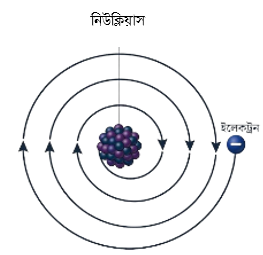
Figure: Limitations regarding atomic structure and electron orbits
