
Bohr’s model of the atom and its limitations
Bohr’s Atomic Model
Based on Max Planck’s Quantum Theory of Radiation, Niels Bohr proposed his famous atomic model in 1913 to explain the stability of atoms and the origin of atomic spectra simultaneously. The three major postulates of Bohr’s atomic model are outlined below:
Major Postulates of Bohr’s Atomic Model
1. Concept of Stationary Orbits or Energy Levels:
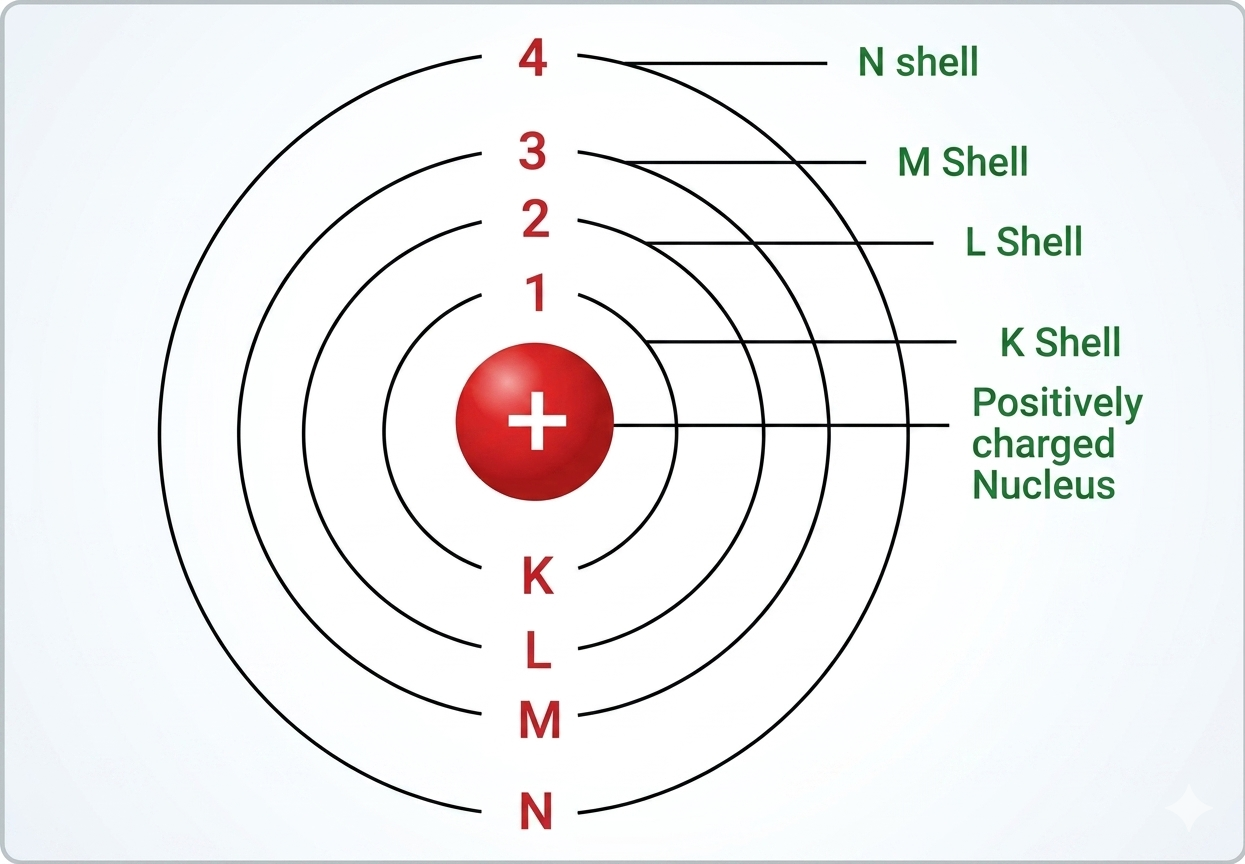
Electrons present in an atom cannot revolve in any arbitrary circular path around the nucleus. Instead, they constantly revolve only in certain permitted circular paths of fixed radii without radiating or losing any energy. These fixed paths are called orbits, shells, or stationary energy levels.
The integers indicating these energy levels are designated as the Principal Quantum Number (n), where n = 1, 2, 3, … etc. These shells are also alphabetically represented as K, L, M, N, … respectively. The energy of the orbit increases progressively as the distance from the nucleus increases.
2. Concept of Angular Momentum of an Electron:
An electron revolving in a specific permitted orbit possesses a fixed or quantized amount of angular momentum, which is an integral multiple of h 2π . If the mass of an electron is m, its linear velocity is v, and the radius of the circular orbit is r, then its angular momentum (mvr) can be expressed by the following equation:
Where, h = Planck’s constant = 6.624 × 10⁻³⁴ J·s and n = Principal Quantum Number.
3. Concept of Energy Absorption, Emission, and Spectrum Formation:
As long as an electron remains and circulates in a specific circular orbit, it neither emits (loses) nor absorbs any energy. That means, although the electron is in motion, the energy of that particular orbit remains constant or stationary.
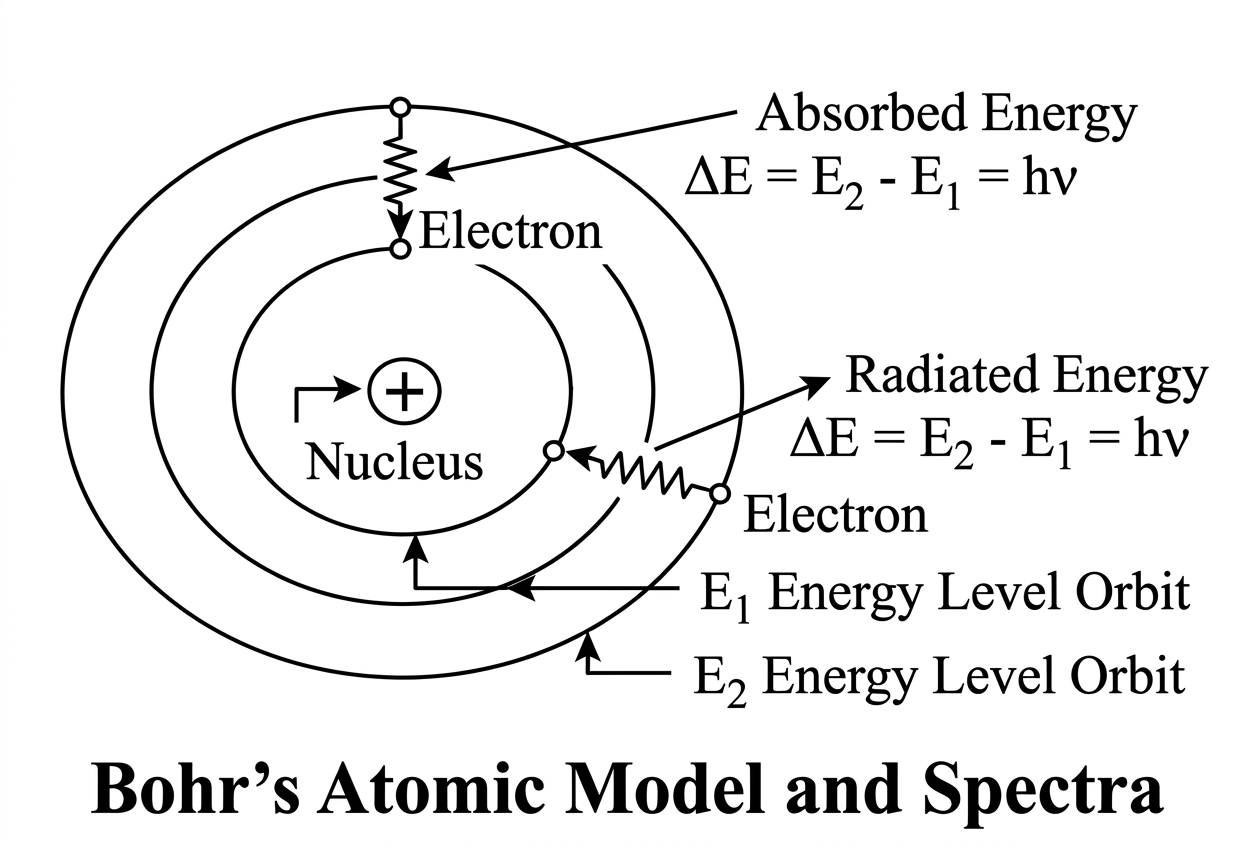
Energy absorption or emission occurs only when an electron jumps (undergoes a transition) from one energy level to another. When an electron transitions from a higher energy level (with energy E2) to a lower energy level (with energy E1), energy is emitted. Conversely, when it transitions from a lower level (E1) to a higher level (E2), energy is absorbed.
Therefore, the amount of absorbed or emitted energy (ΔE) can be calculated using the following equation:
E2 = Energy of the higher energy level
h = Planck’s constant (6.624 × 10⁻³⁴ J·s)
ν (nu) = Frequency of electromagnetic radiation
Limitations of Bohr’s Atomic Model
- This model can successfully explain the spectra of single-electron atoms or ions (e.g., H, He+, Li2+), but it completely fails to explain the atomic spectra of multi-electron atoms or systems.
- According to Bohr’s model, a single spectral line should be observed when an electron transitions between energy levels. However, when examined under high-resolution spectrometers, each individual spectral line is found to be split into multiple closely spaced fine lines. Bohr’s theory cannot explain this fine structure of spectral lines (which was later clarified by Sommerfeld’s modification).
- Bohr’s theory fails to account for or explain Heisenberg’s Uncertainty Principle, as well as the splitting of spectral lines under external magnetic or electric fields, known as the Zeeman effect and Stark effect respectively.
- The model does not explain the fundamental mechanism or physical cause behind why electrons absorb or emit energy exclusively during transitions between stationary states.
- Bohr assumed that the angular momentum of an electron must be equal to an integral multiple of h 2π , but the model fails to provide a theoretical reason or derivation for why it is quantized precisely in this manner.
