
Amager curve and explanation with examples
Amagat’s Curve and Deviation of Real Gases
Question: What is Amagat’s curve? Explain Amagat’s curve.
Answer: To explain the behavior of real gases, French physicist Emile Amagat measured the volume (V) of various gases at constant temperature under different pressures (P) to determine the values of PV. He then plotted the values of PV against P to obtain graphical curves showing the variations of PV. The curves plotted in this manner are known as Amagat’s Curves.
Explanation of Amagat’s Curve:
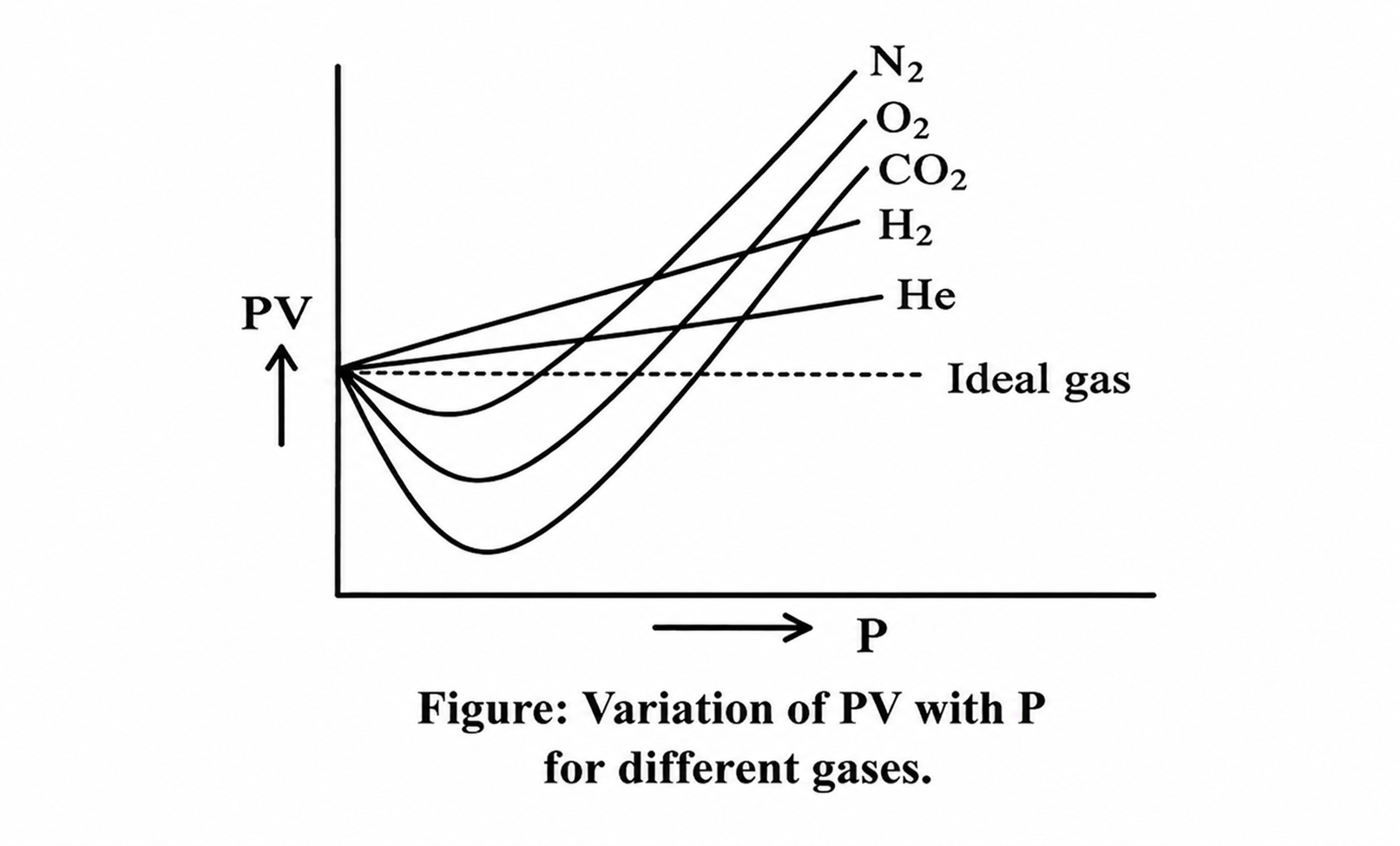
Figure: PV versus P graph for various real gases.
Observing the adjacent graph, it is evident that if the gases were ideal, the value of PV would remain perfectly constant at a fixed temperature, yielding a straight line parallel to the pressure (P) axis. However, for different real gases, the value of PV changes as pressure varies. Amagat obtained two distinct types of curves for real gases:
- First Type of Curve: This type of curve is observed at ordinary temperatures for gases like Hydrogen (H2), Helium (He), and Neon (Ne). For these gases, the value of PV increases continuously with an increase in pressure (P). Consequently, the value of PV for these gases remains greater than the expected value of an ideal gas at all pressures.
- Second Type of Curve: This type of PV versus P curve is observed for gases such as Oxygen (O2), Nitrogen (N2), and Carbon Dioxide (CO2). For these gases, as pressure increases, the value of PV initially decreases to reach a minimum value. Upon further increasing the pressure, the value of PV begins to rise continuously and eventually exceeds the ideal gas value. Thus, changing the pressure alters the PV values for all real gases.
If the temperature is lowered, the curves for gases like H2, He, and Ne change and eventually resemble the curves of O2, N2, and CO2. Conversely, if the temperature is raised significantly, the curves for O2, N2, and CO2 transform to look like those of H2, He, and Ne.
Therefore, it is evident that the nature of deviation does not depend solely on the identity of the gas, but heavily relies on the temperature. Generally, the higher the pressure applied to a gas and the closer its temperature is to its critical temperature, the more significantly it deviates from ideal behavior.
Conclusion: From the above discussion, it is manifest that real gases do not exhibit ideal behavior at high pressures and low temperatures; that is, they do not obey the ideal gas equation (PV = nRT).
