
Identification the Cu2+,Al3+,Fe2+,Fe3+,Zn2+,Ca2+,Na+,NH4+,SO42-,CO32-,Cl- ,Crystal of NaCl,Heat of Solution of Oxalic acid,Chalk Chromatography, and Acidic and Basic Nature of the Soluble Oxides of Elements.
Chemistry First Paper Practical Sheet
Experiment No: 01
Name of the Experiment: Identification of the basic radical and acid radical of the supplied unknown inorganic sample salt.
Sample No: _______________________
a) State: Solid, Crystalline
b) Color: Blue
c) Solubility: Soluble in water.
(1) Dry Test for Basic Radicals
| Sl. | Experiment | Observation | Inference |
|---|---|---|---|
| a | Test tube test: A trace amount of the salt is taken in a clean & dry test tube and heated first gently then strongly. | The salt is blue but becomes black on heating. | Cu2+ salt forms CuO (black). Cu2+ salt may be present. |
| b | Flame test: A platinum wire or glass rod is dipped into conc. HCl contained in a watch glass, touched to the salt, and introduced into the flame. | Bluish-green flame is observed. | Cu2+ salt may be present. |
(2) Wet Test for Basic Radicals
| Sl. | Experiment | Observation | Inference |
|---|---|---|---|
| a | Stock soln + NH4OH added dropwise, then in excess. | Firstly, a light blue ppt. is formed. In excess, a deep blue solution of Tetraamminecopper(II) complex is formed.
2Cu2+ + SO42- + 2NH4OH → CuSO4·Cu(OH)2↓ + 2NH4+
CuSO4·Cu(OH)2 + 8NH4OH → 2[Cu(NH3)4]2+ + SO42- + 2OH– + 8H2O
|
Cu2+ radical is confirmed. |
| b | Stock soln + dropwise NaOH soln + excess solid NH4Cl. | White ppt. is not formed. | Al3+ radical is absent. |
| c | Stock soln + K3[Fe(CN)6] soln. | Deep blue ppt. is not formed. | Fe2+ radical is absent. |
| d | Stock soln + NH4SCN soln. | Blood-red color solution is not formed. | Fe3+ radical is absent. |
| e | Stock soln + dropwise NaOH soln, then in excess. | White ppt. is not formed. | Zn2+ radical is absent. |
| f | Stock soln + Ammonium oxalate soln, then add HCl. | White ppt. is not formed. | Ca2+ radical is absent. |
| g | Stock soln + K2H2Sb2O7 soln. | White ppt. is not formed. | Na+ radical is absent. |
| h | Stock soln + Basic K2[HgI4] (Nessler’s Reagent). | Brown ppt. is not formed. | NH4+ radical is absent. |
(3) Wet Test for Acid Radicals
| Sl. | Experiment | Observation | Inference |
|---|---|---|---|
| a | Barium nitrate test: 1ml Stock soln + dropwise Ba(NO3)2 soln. | White ppt. (BaSO4) is formed which is insoluble in dil. HCl.
SO42- + Ba(NO3)2 → BaSO4↓ + 2NO3–
BaSO4 + HCl → No Change
|
SO42- radical is present. |
| b | Silver nitrate test: Stock soln + dropwise AgNO3 soln. | White ppt. is not formed. | Cl– radical is absent. |
Result: Present radicals in the given sample
a) Basic radical: Copper ion (Cu2+)b) Acid radical: Sulfate ion (SO42-)
Experiment No: 02
Name of the Experiment: Identification of the basic radical and acid radical of the supplied unknown inorganic sample salt.
Sample No: _______________________
a) State: Solid, Crystalline
b) Color: Light green
c) Solubility: Soluble in water.
(1) Dry Test for Basic Radicals
| Sl. | Experiment | Observation | Inference |
|---|---|---|---|
| a | Test tube test: Heat a trace amount of salt in a dry test tube. | Light green salt turns dirty white or yellow on heating. | Fe2+ salt may be present. |
| b | Charcoal cavity test: Salt + twice amount of Na2CO3 heated in charcoal cavity using a blowpipe reducing flame. | Dirty white or ash-colored residue is formed which is attracted by a magnet. | Fe2+ salt may be present. |
(2) Wet Test for Basic Radicals
| Sl. | Experiment | Observation | Inference |
|---|---|---|---|
| a | Stock soln + NH4OH then excess. | Light blue ppt/deep blue soln is not formed. | Cu2+ is absent. |
| b | Stock soln + NaOH + excess solid NH4Cl. | White ppt. is not formed. | Al3+ is absent. |
| c | Stock soln + K3[Fe(CN)6] soln. | Deep blue ppt. (Fe3[Fe(CN)6]2) is formed.
3Fe2+ + 2K3[Fe(CN)6] → Fe3[Fe(CN)6]2↓ + 6K+
|
Fe2+ radical is confirmed. |
| d | Stock soln + NH4SCN soln. | Blood-red solution is not formed. | Fe3+ is absent. |
| e | Stock soln + NaOH then excess. | White ppt. is not formed. | Zn2+ is absent. |
| f | Stock soln + Ammonium oxalate soln. | White ppt. is not formed. | Ca2+ is absent. |
| g | Stock soln + K2H2Sb2O7 soln. | White ppt. is not formed. | Na+ is absent. |
| h | Stock soln + Nessler’s Reagent. | Brown ppt. is not formed. | NH4+ is absent. |
(3) Wet Test for Acid Radicals
| Sl. | Experiment | Observation | Inference |
|---|---|---|---|
| a | Barium nitrate test: Stock soln + Ba(NO3)2 soln. | White ppt. (BaSO4) is formed, insoluble in dil. HCl.
SO42- + Ba(NO3)2 → BaSO4↓ + 2NO3–
|
SO42- radical is present. |
| b | Silver nitrate test: Stock soln + AgNO3 soln. | White ppt. is not formed. | Cl– is absent. |
Result: Present radicals in the given sample
a) Basic radical: Ferrous ion (Fe2+)b) Acid radical: Sulfate ion (SO42-)
Experiment No: 03
Name of the Experiment: Identification of the basic radical and acid radical of the supplied unknown inorganic sample salt.
Sample No: _______________________
a) State: Solid, Crystalline
b) Color: Blackish Red
c) Solubility: Soluble in water.
(1) Dry Test for Basic Radicals
| Sl. | Experiment | Observation | Inference |
|---|---|---|---|
| a | Test tube test: Heat salt in a dry test tube. | Brown residue is formed when hot and cold. | Fe salt may be present. |
| b | Charcoal cavity test: Salt + Na2CO3 + reduction flame. | Ash colored residue is formed, attracted by a magnet. | Fe salt may be present. |
(2) Wet Test for Basic Radicals
| Sl. | Experiment | Observation | Inference |
|---|---|---|---|
| a | Stock soln + NH4OH then excess. | No light blue ppt or deep blue soln. | Cu2+ is absent. |
| b | Stock soln + NaOH + NH4Cl. | White ppt. is not formed. | Al3+ is absent. |
| c | Stock soln + K3[Fe(CN)6] soln. | Deep blue ppt. is not formed. | Fe2+ is absent. |
| d | Stock soln + NH4SCN soln. | Blood-red color solution of Fe(SCN)3 is formed.
Fe3+ + 3NH4SCN → Fe(SCN)3 + 3NH4+
|
Fe3+ radical is confirmed. |
| e | Stock soln + NaOH then excess. | White ppt. is not formed. | Zn2+ is absent. |
| f | Stock soln + Ammonium oxalate soln. | White ppt. is not formed. | Ca2+ is absent. |
| g | Stock soln + K2H2Sb2O7 soln. | White ppt. is not formed. | Na+ is absent. |
| h | Stock soln + Nessler’s Reagent. | Brown ppt. is not formed. | NH4+ is absent. |
(3) Wet Test for Acid Radicals
| Sl. | Experiment | Observation | Inference |
|---|---|---|---|
| a | Barium nitrate test: Stock soln + Ba(NO3)2 soln. | White ppt. is not formed. | CO32- & SO42- are absent. |
| b | Silver nitrate test: Stock soln + AgNO3 soln. | White ppt. (AgCl) is formed, soluble in excess NH4OH but invisible in dil. HNO3.
Cl– + AgNO3 → AgCl↓ + NO3–
AgCl↓ + 2NH4OH → [Ag(NH3)2]Cl + 2H2O
[Ag(NH3)2]Cl + 2HNO3 → AgCl↓ + 2NH4NO3
|
Cl– radical is present. |
Result: Present radicals in the given sample
a) Basic radical: Ferric ion (Fe3+)b) Acid radical: Chloride ion (Cl–)
Experiment No: 04
Name of the Experiment: Identification of the basic radical and acid radical of the supplied unknown inorganic sample salt.
Sample No: _______________________
a) State: Solid, Crystalline
b) Color: White
c) Solubility: Soluble in water.
(1) Dry Test for Basic Radicals
| Sl. | Experiment | Observation | Inference |
|---|---|---|---|
| a | Test tube test: Heat salt in a dry test tube. | Residue is yellow when hot and white when cold. | Zn2+ salt may be present. |
| b | Charcoal cavity test: Salt + Na2CO3 + heating. | Yellow when hot and white when cold residue. | Zn2+ salt may be present. |
(2) Wet Test for Basic Radicals
| Sl. | Experiment | Observation | Inference |
|---|---|---|---|
| a | Stock soln + NH4OH then excess. | No blue ppt or solution. | Cu2+ is absent. |
| b | Stock soln + NaOH + NH4Cl. | White ppt. is not formed. | Al3+ is absent. |
| c | Stock soln + K3[Fe(CN)6] soln. | Deep blue ppt. is not formed. | Fe2+ is absent. |
| d | Stock soln + NH4SCN soln. | Blood-red solution is not formed. | Fe3+ is absent. |
| e | Stock soln + dropwise NaOH soln, then in excess. Then pass H2S gas. | White ppt of Zn(OH)2 forms first, dissolves in excess to give clear Na2ZnO2. Passing H2S yields a white ppt. (ZnS).
Zn2+ + 2NaOH → Zn(OH)2↓ + 2Na+
Zn(OH)2 + 2NaOH → Na2ZnO2 + 2H2O
Na2ZnO2 + H2S → ZnS↓ + 2NaOH
|
Zn2+ radical is confirmed. |
| f | Stock soln + Ammonium oxalate soln. | White ppt. is not formed. | Ca2+ is absent. |
| g | Stock soln + K2H2Sb2O7 soln. | White ppt. is not formed. | Na+ is absent. |
| h | Stock soln + Nessler’s Reagent. | Brown ppt. is not formed. | NH4+ is absent. |
(3) Wet Test for Acid Radicals
| Sl. | Experiment | Observation | Inference |
|---|---|---|---|
| a | Barium nitrate test: Stock soln + Ba(NO3)2 soln. | White ppt. (BaSO4) is formed, insoluble in dil. HCl.
SO42- + Ba(NO3)2 → BaSO4↓ + 2NO3–
|
SO42- radical is present. |
| b | Silver nitrate test: Stock soln + AgNO3 soln. | White ppt. is not formed. | Cl– is absent. |
Result: Present radicals in the given sample
a) Basic radical: Zinc ion (Zn2+)b) Acid radical: Sulfate ion (SO42-)
Experiment No: 05
Name of the Experiment: Identification of the basic radical and acid radical of the supplied unknown inorganic sample salt.
Sample No: _______________________
a) State: Solid, Crystalline
b) Color: White
c) Solubility: Soluble in water.
(1) Dry Test for Basic Radicals
| Sl. | Experiment | Observation | Inference |
|---|---|---|---|
| a | Test tube test: Heat salt in a dry test tube. | No characteristic observation. | Ca2+ salt may be present. |
| b | Flame test: Salt pasted with conc. HCl and introduced to flame. | Brick red flame is observed. | Ca2+ salt may be present. |
(2) Wet Test for Basic Radicals
| Sl. | Experiment | Observation | Inference |
|---|---|---|---|
| a | Stock soln + NH4OH then excess. | No blue ppt or solution. | Cu2+ is absent. |
| b | Stock soln + NaOH + NH4Cl. | White ppt. is not formed. | Al3+ is absent. |
| c | Stock soln + K3[Fe(CN)6] soln. | Deep blue ppt. is not formed. | Fe2+ is absent. |
| d | Stock soln + NH4SCN soln. | Blood-red solution is not formed. | Fe3+ is absent. |
| e | Stock soln + NaOH then excess. | White ppt. is not formed. | Zn2+ is absent. |
| f | Stock soln + Ammonium oxalate [(NH4)2C2O4] soln, then add dil. HCl. | White ppt. (CaC2O4) is formed which is soluble in dil. HCl.
Ca2+ + (NH4)2C2O4 → CaC2O4↓ + 2NH4+
CaC2O4 + 2HCl → CaCl2 + H2C2O4
|
Ca2+ radical is confirmed. |
| g | Stock soln + K2H2Sb2O7 soln. | White ppt. is not formed. | Na+ is absent. |
| h | Stock soln + Nessler’s Reagent. | Brown ppt. is not formed. | NH4+ is absent. |
(3) Wet Test for Acid Radicals
| Sl. | Experiment | Observation | Inference |
|---|---|---|---|
| a | Barium nitrate test: Stock soln + Ba(NO3)2 soln. | White ppt. is not formed. | CO32- & SO42- are absent. |
| b | Silver nitrate test: Stock soln + AgNO3 soln. | White ppt. (AgCl) is formed, soluble in excess NH4OH but invisible in dil. HNO3.
Cl– + AgNO3 → AgCl↓ + NO3–
|
Cl– radical is present. |
Result: Present radicals in the given sample
a) Basic radical: Calcium ion (Ca2+)b) Acid radical: Chloride ion (Cl–)
Experiment No: 06
Name of the Experiment: Identification of the basic radical and acid radical of the supplied unknown inorganic sample salt.
Sample No: _______________________
a) State: Solid, Crystalline
b) Color: White
c) Solubility: Soluble in water.
(1) Dry Test for Basic Radicals
| Sl. | Experiment | Observation | Inference |
|---|---|---|---|
| a | Test tube test: Heat salt in a dry test tube. | Pungent smelling gas (NH3) comes out which gives dense white fumes with a glass rod moistened with conc. HCl. | NH4+ salt may be present.
NH3 + HCl → NH4Cl (White fume)
|
| b | NaOH solution test: Take a small quantity of salt, add conc. NaOH solution and heat. | Pungent smelling gas (NH3) comes out which gives dense white fumes with conc. HCl. | NH4+ salt may be present. |
(2) Wet Test for Basic Radicals
| Sl. | Experiment | Observation | Inference |
|---|---|---|---|
| a | Stock soln + NH4OH then excess. | No blue ppt or solution. | Cu2+ is absent. |
| b | Stock soln + NaOH + NH4Cl. | White ppt. is not formed. | Al3+ is absent. |
| c | Stock soln + K3[Fe(CN)6] soln. | Deep blue ppt. is not formed. | Fe2+ is absent. |
| d | Stock soln + NH4SCN soln. | Blood-red solution is not formed. | Fe3+ is absent. |
| e | Stock soln + NaOH then excess. | White ppt. is not formed. | Zn2+ is absent. |
| f | Stock soln + Ammonium oxalate soln. | White ppt. is not formed. | Ca2+ is absent. |
| g | Stock soln + K2H2Sb2O7 soln. | White ppt. is not formed. | Na+ is absent. |
| h | Stock soln + Basic K2[HgI4] (Nessler’s Reagent) + KOH. | A brown precipitate of iodide of Millon’s base (NH2Hg2I3) is formed.
2NH4+ + 2[HgI4]2- + 4OH– → NH2Hg2I3↓ + 5I– + 4H2O
|
NH4+ radical is confirmed. |
(3) Wet Test for Acid Radicals
| Sl. | Experiment | Observation | Inference |
|---|---|---|---|
| a | Barium nitrate test: Stock soln + dropwise Ba(NO3)2 soln. | White ppt. (BaCO3) is formed which is soluble in dil. HCl with effervescence.
CO32- + Ba(NO3)2 → BaCO3↓ + 2NO3–
BaCO3 + 2HCl → BaCl2 + CO2↑ + H2O
|
CO32- radical is present. |
| b | Silver nitrate test: Stock soln + AgNO3 soln. | White ppt. is not formed. | Cl– is absent. |
Result: Present radicals in the given sample
a) Basic radical: Ammonium ion (NH4+)b) Acid radical: Carbonate ion (CO32-)
Experiment No: 07
Name of the Experiment: To obtain pure crystal of NaCl salt from impure common salt (NaCl).
A. Theory
The salt obtained from sea water and rock salt contains different kinds of impurities like calcium chloride (CaCl2), magnesium chloride (MgCl2), calcium sulfate (CaSO4), magnesium sulfate (MgSO4), sodium sulfate (Na2SO4) and many insoluble impurities. The insoluble impurity is removed by filtering through a filter paper.
The filtrate is then heated to make a saturated solution and then concentrated hydrochloric acid (HCl) is added to increase the concentration of chloride ion (Cl–) in the solution. As a result, the ionic product of Na+ and Cl– ions becomes more than the solubility product (Ksp) of NaCl. Pure sodium chloride (NaCl) is separated from the solution due to the common ion effect. But the soluble impurities are left in the solution.
- 1. Sample of common salt (NaCl)
- 2. Concentrated hydrochloric acid (HCl)
- i. Beaker-250 mL, ii. Funnel, iii. Porcelain basin
- iv. Glass rod, v. Tripod stand, vi. Filter paper
- vii. Wire gauge, viii. Bunsen burner etc.
D. Procedure
- 5 g impure common salt and a little water is taken in a beaker. Then it is stirred with a glass rod to prepare the solution.
- The solution is filtered and the filtrate is taken in a beaker.
- The solution is heated to make a saturated solution. A little of the solution is taken in a test-tube and cooled with tap-water. If crystals are formed on cooling then the solution is saturated.
- When the solution becomes cold small amounts of (5-6 drops) concentrated hydrochloric acid is added to the solution. As a result, crystals of pure sodium chloride are formed. When crystals of sodium chloride are collected at the bottom of the beaker more hydrochloric acid is added slowly to end the process of crystallization.
- The crystals are separated by a filter paper and washed with concentrated sodium chloride solution. Then the crystals are taken in an open container and heated this evaporates the hydrochloric acid attached to the crystals. Hence dry crystals are obtained which are kept in air to make them really dry.
- The crystals can be dried more quickly by keeping them in desiccators filled with melted calcium chloride (CaCl2).

E. Calculations
| Mass of common salt (W1) | 5 g |
| Mass of pure crystals (W2) | 4 g |
5 g impure salt contains 4 g pure salt.
∴ 100 g impure salt contains = 4 × 100 5 g pure salt = 80 g pure salt.
Therefore, percentage of pure salt present is 80%.
F. Result
Physical properties of obtained crystals of pure sodium chloride (NaCl):
1. Color: White2. Shape : Cubic
- Too much water should not be used to prepare a saturated solution of sodium chloride.
- The solution should not be concentrated too much. This may give you only a solid mass and no crystals.
- The saturated solution should be cooled slowly and not rapidly to get good quality of crystals.
Experiment No: 08
Name of the Experiment: Determination of heat of solution of oxalic acid (HOOC – COOH.2H2O).
A. Theory
The change of heat (evolved or absorbed) when one mole or one gram-molecule of solute is dissolved in a large amount of solvent is called the heat of solution of that solute. Here, the volume of solvent must be so large that the addition of further amount of solvent to the solution will not affect the change of heat i.e., at infinite dilution.
In the laboratory, the solution of one mole of solute is prepared in such a way so that the total mass of the solution becomes 1 kilogram. Then the heat change of the solution for every degree Celsius change of temperature is 4.2 kJ. So, if the temperature rise or fall is t°C to prepare one kg of the solution by dissolving one mole of the solute in water, then the heat of solution of that solute will be (4.2 × t) kJ mol-1.
When 0.1 mole instead of 1 mole of solute is dissolved in water to make 100g of the solution, then:
∴ Heat of solution of the solute = 0.42 × t 0.1 kJ mol-1
= (0.42 × t × 10) kJ mol-1
= (4.2 × t) kJ mol-1
- Oxalic acid (H2C2O4. 2H2O)
- Water
- 1. Beaker (250 mL), 2. Calorimeter
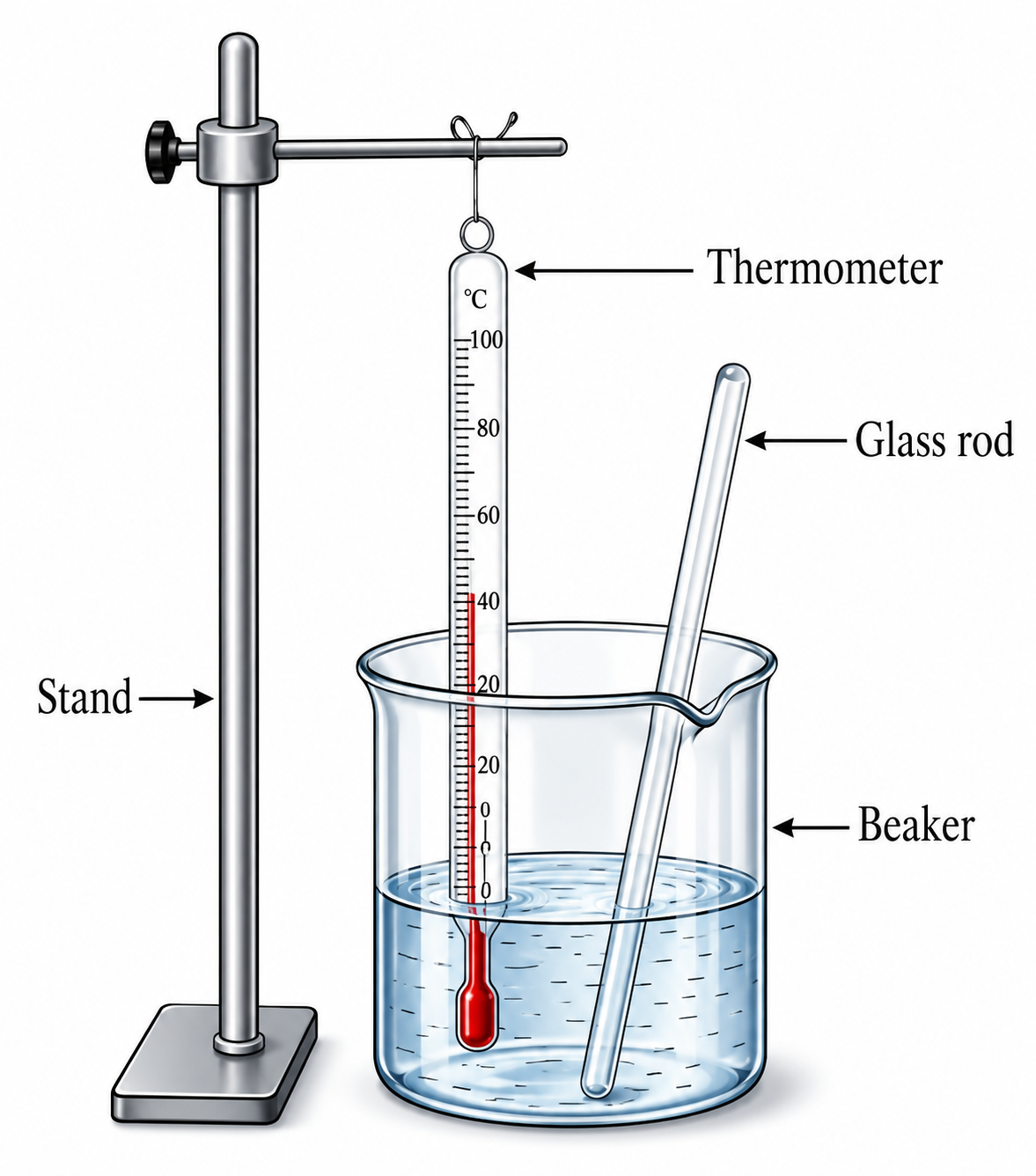
- 3. Glass rod (stirrer), 4. Thermometer (110°C)
- 5. Stand, 6. Clamp, 7. Measuring cylinder (100 mL)
D. Procedure
- Molecular mass of hydrated oxalic acid (HOOC-COOH.2H2O) is 126. So, one mole of oxalic acid is equal to 126g of oxalic acid. Now 0.05 mole oxalic acid means 6.3g oxalic acid.
- 43.7g of water is taken in a beaker of 250 mL and arranged according to the experimental setup figure below.
[The solution will be 50g if 6.3 g of oxalic acid is added to 43.7 g of water.] - The thermometer is immersed into water and the initial temperature of water is recorded.
- Now 6.3 g of oxalic acid is added to the water and stirred gently with a glass rod so that the solute is completely dissolved in water to make a uniform solution.
- The lowest temperature (t2°C) is recorded after completely dissolving all the oxalic acid.
- Then the heat of solution is calculated using the observed data.
E. Observation Data
| Taken weight of oxalic acid | 6.3 g (or 0.05 mole) |
| Mass of water | 43.7 g |
| Concentration of the solution | 1 M |
| Initial temperature of water (t1) | 30°C |
| Finally the lowest temperature of the oxalic acid solution (t2) | 25.5°C |
F. Calculations
Change of temperature, t°C = (t1 – t2)
= (30 – 25.5)°C = 4.5°C
∴ Heat of solution of oxalic acid, ΔH = (4.2 × t) kJ mol-1
= +(4.2 × 4.5) kJ mol-1
= +18.9 kJ mol-1
Heat is absorbed when oxalic acid is dissolved in water. So this process is an endothermic process. Hence, the heat of solution of oxalic acid is positive.
G. Result
Heat of solution of oxalic acid, ΔH = +18.9 kJ mol-1
- As soon as possible, oxalic acid should be dissolved in water by stirring with a glass rod.
- The solution should be stirred carefully with a glass rod so that the thermometer bulb is not hit or broken.
- Stirring should be uniform throughout the experiment to ensure proper temperature tracking.
Experiment No: 09
Name of the Experiment: Separation of compounds from the mixture with the help of chalk chromatography.
A. Theory
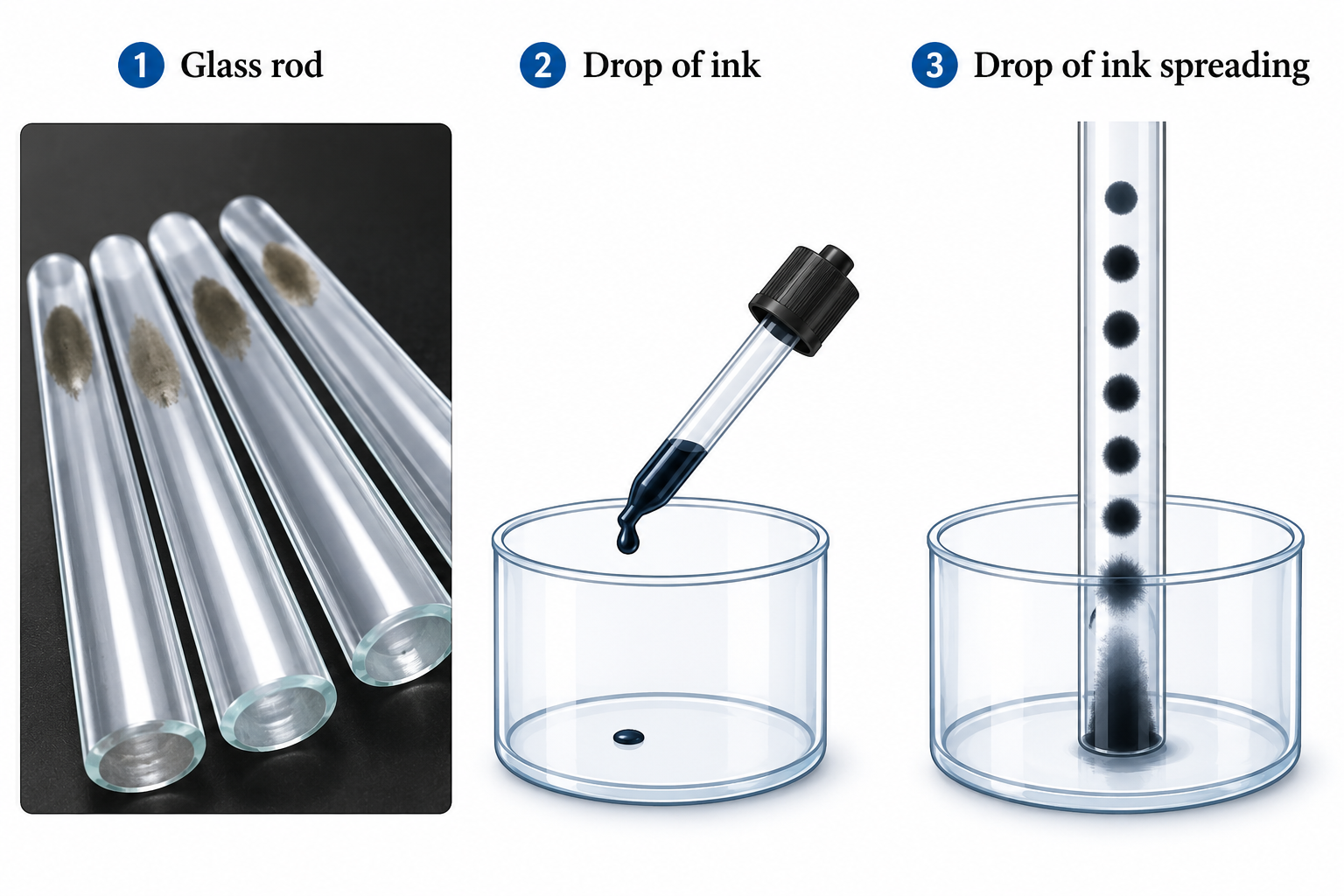
Chalk chromatography is a type of column chromatography. The method of column chromatography can be carried out in the classroom using calcium carbonate (CaCO3) in the form of sticks of chalk. A mixture containing two or more components is deposited on a stick of chalk, which acts as a solid adsorbing substance.
The components are adsorbed (i.e., held on the surface of the solid substance) to varying degrees which depend on the nature of the component, the nature of the adsorbent, and the temperature. Then the wash solvent (liquid) is added to the adsorbent and allowed to flow through it by capillary effect. As the solvent passes the deposited mixture, the components tend to be dissolved to varying extents and are swept along the solid adsorbent.
The rate at which a component will move along the solid depends on its relative tendency to be dissolved in the solvent and its tendency to be adsorbed on the solid. The net effect is that, as the solvent passes slowly through the solid adsorbent, the components of the mixture separate from each other and move along with the solvent, forming rather diffuse zones or spots. With the proper choice of solvent and adsorbent, it is possible to resolve many complex mixtures into their pure components.
- White chalk (2 pcs)
- Water-Ethanol mixture (25%)
- Felt tip pens or Markers
- Beaker (250 mL or 100 mL)
- Measuring cylinder
- Pencil
D. Procedure
- A stick of chalk is taken. Using a felt-tip pen or marker, a line is drawn around the chalk about 1 to 1.5 cm from the bottom end. Note: It may be necessary to draw the line as a series of small dots as the chalk may clog the tip of the felt-tip pen.
- If the felt-tip pens are of the “washable” type, then the inks are water-soluble. In this case, 5 mL of water is taken in a 3-ounce cup/beaker.
- If the felt-tip pens contain a permanent-type ink, then alcohol or an alcohol-water solvent must be used. 5 mL of 25% alcohol solution is taken in a 3-ounce cup/beaker. Note: If you are not sure of the type of ink used in the felt-tip pen, try using water as the solvent first. Then repeat the procedure using a water-alcohol solution. Different results may occur when water and alcohol-water solvents are used with the same felt-tip pens.
- The chalk is stood vertically in the cup with the end containing the marker line facing downwards. This setup is allowed to remain undisturbed for 15 to 30 minutes. The liquid should rise up the chalk to within 1 cm of the top.
- The chalk is carefully removed from the cup. Using a pencil, the highest position on the chalk that the solvent (liquid front) has reached is immediately marked.
- The chalk is left aside to dry completely.
- The separated ink components from the felt-tip pen on the chalk are examined, and the visual changes of the ink are described.
- The experiment is repeated with other felt-tip pens. The identity of each felt-tip pen used is recorded (For example: a “red Flair” marker may be used).
-
The position of the separated components can be identified by physical or chemical processes. The distance traveled by the separated components is expressed by the value of Rf (Retardation Factor value), where:
Rf = Distance traveled by the separated component Distance traveled by the solvent front
- Safety goggles or protective glasses should be worn at all times in the laboratory.
- The alcohol used in this experiment is poisonous and highly flammable. It must be kept covered to minimize toxic fumes. Under no circumstances should anyone attempt to drink it.
- There must be absolutely no open flames or burners active in the laboratory during this experiment.
Experiment No: 10
Name of the Experiment: Determination of acidic and basic nature of the soluble oxides of elements.
A. Theory
The metallic oxides that are soluble in water produce strong alkalis (bases), whereas the non-metallic oxides that are soluble in water produce acids. The acidic or basic nature of these soluble oxides can be easily detected in the laboratory with the help of litmus paper, universal indicator, pH paper, or a pH meter.
- Lime or Calcium oxide (CaO)
- Barium oxide (BaO)
- Carbon dioxide (CO2) gas
- Sulfur dioxide (SO2) gas
- Sodium sulfite (Na2SO3)
- Hydrochloric acid (HCl)
- Distilled water
- Marble chips (CaCO3)
- Litmus paper (Red/Blue), Universal indicator, or pH paper / pH meter
- 1. Test tubes
- 2. Bent gas delivery tube
- 3. Cork
D. Procedure
- A small amount of CaO is taken in a test tube and distilled water is added. It is then shaken thoroughly to prepare the solution. In this solution, first a red litmus paper and then a blue litmus paper is introduced. The color changes of the litmus papers are observed and recorded.
- A small amount of BaO is taken in another test tube, distilled water is added, and it is shaken well to form a solution. Red and blue litmus papers are dipped into the solution sequentially, and the color observations are recorded.
- A trace amount of Na2SO3 is taken in a test tube, and dilute HCl acid is added to it. The test tube is immediately sealed with a cork connected to a bent gas delivery tube. The generated SO2 gas is passed into another test tube containing distilled water. Red and blue litmus papers are tested in this aqueous solution, and the results are noted.
- A small amount of marble chips (CaCO3) is taken in a test tube, and HCl acid is added. The test tube is quickly fitted with a cork and gas delivery tube to pass the evolved CO2 gas into water taken in a separate test tube. The resulting solution is tested with both red and blue litmus papers, and the observations are recorded.
Data & Observation Table
| Sl No. | Oxide Solution | Color of Red Litmus Paper with Soln | Color of Blue Litmus Paper with Soln | Inference | |
|---|---|---|---|---|---|
| Nature | Value of pH | ||||
| (1) | Solution of CaO | Blue | Blue | Basic | More than 7 |
| (2) | Solution of BaO | Blue | Blue | Basic | More than 7 |
| (3) | Solution of SO2 | Red | Red | Acidic | Less than 7 |
| (4) | Solution of CO2 | Red | Red | Acidic | Less than 7 |
- Safety goggles or protective glasses must be worn at all times in the laboratory.
- The color change of the litmus paper in each solution must be observed carefully and recorded immediately.
Experiment No: 11
Name of the Experiment: Food Canning.
A. Theory
The process of preserving any food in a container by applying heat and sealing it under air-tight conditions is called canning. In 1810, a Frenchman named Nicolas Appert first gave the concept of canning. Canning is highly effective in preventing food items from spoiling or rotting over extended periods.
Principle of Food Preservation by Canning:
The heat tolerance capacity of a microorganism or germ is expressed by its Thermal Death Time (TDT). At a constant temperature, the minimum time required for the absolute destruction of germs and their spores is called TDT. It directly depends on the nature of the food, the initial microbial load, and the types of spores present.
In standard food containers, maintaining a processing temperature of 121°C that persists for 30 minutes destroys all the viable pathogens and spores inside the container. As a result, the food remains perfectly preserved unless there is a structural leak or hole in the can. The container must be kept strictly air-tight. Through this standard process, canned food remains in optimal condition for 2 to 3 years.
B. Procedure of Canning
The operational process of food canning involves several sequential and precise steps as outlined below:
-
1. Collection of Raw Materials:
Special care should be taken during the collection of raw materials. They must be fresh, wholesome, and of premium standard quality. If the raw materials are contaminated or sub-standard, the final manufactured food will not meet safe preservation standards. -
2. Selection and Grading:
Sorting and grouping of raw materials are performed based on their size, shape, color, maturity (raw or ripe), and overall structural characteristics. Non-uniform sizes can lead to uneven cooking during subsequent thermal processing (e.g., smaller pieces overcooking while larger pieces remain undercooked). Therefore, uniform grading is essential. -
3. Cleaning:
Thoroughly washing raw materials with clean water removes surface dirt, residual insecticides, debris, and a significant portion of surface microbes. This step minimizes any potential source of spoilage and improves the aesthetic appeal of the preserved food. -
4. Peeling:
Most fruits and vegetables possess a naturally protective outer skin or rind that is tough and non-edible. Proper peeling is required to extract the pure edible pulp or tissue for canning. -
5. Cutting:
Large-sized raw materials are difficult to accommodate efficiently inside a standard can. Slicing or dicing them into uniform small pieces ensures even heat penetration during blanching, maximizes filling efficiency, and helps maintain accurate net weights. -
6. Blanching:
Blanching is the brief process of immersing fruits or vegetables in hot water (or steam) at a controlled temperature for 5 to 10 minutes, followed by rapid cooling.Major benefits of blanching:- It cleanses the tissue surface and reduces the overall microbial load.
- It expels intercellular gases (oxygen) from the plant tissues, inhibiting the survival and propagation of aerobic micro-organisms.
- It inactivates naturally occurring destructive enzymes that cause discoloration or flavor degradation.
- It fixes and enhances the natural brightness of colors in fruits and vegetables.
-
7. Syruping / Brining:
While filling the containers, a hot sugar solution (syrup) is added to fruits, and a salt solution (brine) is added to vegetables. This fills up the gaps between food pieces to facilitate uniform heat conduction. A precise small clearance, known as the head space, is left empty at the top of the container. -
8. Exhausting:
Exhausting is the process of removing residual air and oxygen from the container’s head space using hot water vapor. Adding the syrup or brine while it is still hot (80°C – 85°C) aids in creating a internal vacuum by displacing air with steam. Minimizing oxygen prevents the proliferation of aerobic spoilage organisms and checks internal chemical/corrosive reactions. -
9. Sealing:
Immediately after exhausting, the container is hermetically sealed using a double-seaming machine. It must be perfectly air-tight to prevent any external atmospheric air or contaminants from re-entering the container. -
10. Processing (Sterilization):
The sealed cans are transferred to a thermal sterilizer (retort/autoclave). General vegetable and low-acid cans are processed at 121°C for 30 minutes to eliminate all resilient bacterial spores. Highly acidic fruits and fruit-based products are typically sterilized at 100°C. -
11. Cooling:
Following thermal processing, the containers are immediately cooled down under running tap water until their temperature drops to about 40°C – 45°C. The residual heat left at this stage allows the exterior of the cans to dry quickly by self-evaporation, preventing rust during warehouse storage. Improper cooling can lead to overcooking, causing loss of natural color, texture, and aroma.
Experiment No: 12
Name of the Experiment: Preparation of Vinegar.
A. Principle
Vinegar is a dilute solution of ethanoic acid (acetic acid). Generally, 5.5% to 10% ethanoic acid is present in standard vinegar. Commercially, ethanoic acid is prepared from ethanol through fermentation or chemical oxidation. In the following laboratory experiment, synthetic vinegar will be systematically produced from pure ethanoic acid.
- Distilled Water
- Ethanoic acid (Glacial)
- Caramel color (Burnt sugar)
- Commercial Sugar
- 1. Beaker (250 mL)
- 2. Glass rod (Stirrer)
- 3. Small heating pot / Porcelain dish
- 4. Funnel & Filter paper
- 5. Airtight glass bottle

D. Working Procedure
- Approximately 150 mL of distilled water is boiled thoroughly in a beaker and then kept undisturbed for a short duration to let any undissolved particulate matter sediment completely at the bottom.
- Clear water from the top surface is carefully decanted and filtered using standard filter paper.
- Exactly 50 mL of this purified, lukewarm water is measured out into a clean beaker, and 5 mL of concentrated ethanoic acid is mixed into it uniformly using a glass rod.
- Now, 5 g (or roughly one teaspoon) of commercial sugar is taken in a small metal pot or porcelain dish and heated continuously over a mild flame until it melts, caramelizes, and turns into a deep brown or blackish color.
- This burnt sugar is removed from the heat source and allowed to cool down, causing it to harden.
- The intense color of this hardened burnt sugar is then extracted by adding the previously prepared acid-water mixture very slowly over it with continuous stirring.
- The solution is mixed thoroughly until the color of the entire liquid sample converts completely into a uniform characteristic brown color.
- The freshly produced synthetic vinegar is transferred into a thoroughly cleaned, narrow-mouthed, sterilized airtight glass bottle and sealed tightly.
The deep brown color obtained by heating sugar is professionally known as caramel. This prepared synthetic vinegar is non-toxic, structurally stable, and is widely utilized as a food preservative and flavoring agent in the preparation of commercial sauces, chatni, pickles, and food preserves.
- Concentrated ethanoic acid emits sharp, pungent fumes. It should always be measured and transferred carefully using a pipette fitted with a proper manual pipette filler.
- The storage glass bottle containing the prepared vinegar must be kept tightly sealed with an airtight cork or lid to eliminate microbial contamination or atmospheric evaporation.
Tag:Al3+, Ca2+, Chalk Chromatography, Cl-, CO32-, Crystal of NaCl, Cu2+, Fe2+, Fe3+, Heat Of Oxalic acid, Na+, NH4+, SO42-, Zn2+
