
Vinegar preparation, food preservation techniques with vinegar, limitations of vinegar, importance of vinegar in food preservation
Preparation of Malt Vinegar from Sugarcane Juice
High-quality juicy sugarcanes are collected, and their leaves, roots, and outer barks are removed before cutting them into small pieces. Then, the pieces are thoroughly washed with clean water and kept vertically for some time to drain off the excess water completely. Afterward, the sugarcane pieces are crushed properly to extract the juice.
Naturally, sugarcane juice contains about 3% – 4% sugar. The extracted juice is filtered through a clean, soft cloth and then slowly heated in a large pan to evaporate the water until the volume of the solution is reduced to one-fifth (1/5) of its original volume. This concentrated solution now contains about 10% sugar.
The concentrated solution is then cooled down, and nutrients like ammonium sulfate, (NH4)2SO4, and ammonium phosphate, (NH4)3PO4, are added and stirred well with a stick. Next, the solution is maintained at a temperature of 25°C – 30°C, yeast is added, and the mixture is stirred again. The container is then covered with a perforated lid, wrapped with a towel, and kept undisturbed for three days.
During this period, the fermentation process takes place. Yeast secretes two vital enzymes: Invertase and Zymase. The secreted invertase enzyme hydrolyzes the sucrose (sugar) in the juice into glucose and fructose. Then, the zymase enzyme converts this glucose and fructose into ethanol and carbon dioxide.
1. Fermentation Reactions (By Yeast):
| C12H22O11 + H2O |
Invertase, 30°C
|
C6H12O6 (Glucose) + C6H12O6 (Fructose) |
| C6H12O6 + C6H12O6 |
Zymase
|
2CH3CH2OH + 4CO2 |
At the end of this fermentation process, the solution contains approximately 10% ethanol. This alcohol solution is then used to produce vinegar. In the presence of oxygen and the bacterium Mycoderma aceti, the 10% ethanol solution undergoes aerobic oxidation to convert into a 6% – 10% ethanoic acid (acetic acid) solution.
2. Oxidation Reaction (By Mycoderma aceti):
| CH3CH2OH + O2 |
Mycoderma aceti
|
CH3COOH + H2O |
Aging Process:
The 6% – 10% dilute ethanoic acid produced through this method is collected, filtered, and stored in a clean container in a dark place for three months. This step is called Aging. The longer the aging period, the better the aroma, flavor, and quality of the vinegar.
Food Preservation Technique of Vinegar
In reality, our food components are long-chain polymeric compounds. These polymeric structures of food are broken down under the influence of numerous microorganisms that thrive under various environmental conditions. As a result, the taste and characteristics of the food are ruined, leading to a foul odor. Therefore, to protect food from spoilage, measures must be taken to prevent the growth of such microorganisms that destroy the food structure.
Vinegar is a highly widely used and conventional natural food preservative, also known in the market as Sirka. It is inexpensive, easily available, and keeps the qualitative value of food unaltered. Furthermore, it has no side effects and dissolves easily in water. Vinegar is an incomparable preservative in preparing and storing various food items, such as pickles, chutneys, jellies, jams, marmalades, and in preserving fruits, vegetables, fish, and meat.
The Mechanism of Preservation:
However, applying salt along with vinegar makes the preservation even more effective. Since salt is a hygroscopic substance, adding it extracts excess water from the food materials. Due to this lack of moisture or water, bacteria cannot survive, and it also prevents the concentration of vinegar from getting diluted.
Ethanoic acid is a weak acid; when used in food, it partially ionizes to release H+ ions. These released H+ ions bind with the lone pair of electrons on the nitrogen atom, neutralizing that active site of the protein chain.
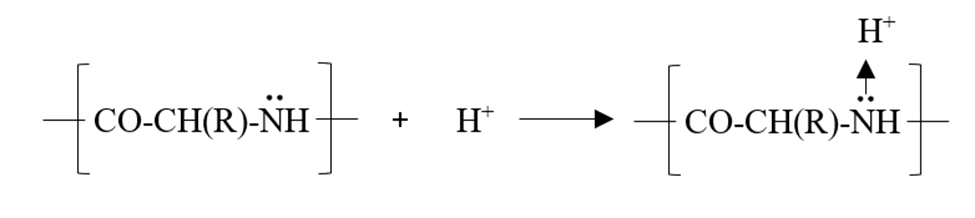
Figure: Mechanism of bacterial enzyme deactivation by vinegar.
As a result, the enzyme can no longer carry out its catalytic action, and the spoilage fermentation process comes to a complete halt. Consequently, the food remains protected and safe. The higher the concentration of H+ ions, the more unfavorable the environment becomes for microorganisms. This is exactly how vinegar preserves food.
- iii. Safe for Body pH: Since vinegar is a mild organic acid, consuming it with food poses no risk of increasing harmful internal acidity; rather, it helps maintain the optimal pH balance of the food and the body.
- iv. Uniform Distribution: Because it is completely miscible in an aqueous medium, it easily mixes with the water content of food, maintaining a uniform concentration everywhere to build up a consistent defense against microbes.
- v. High Boiling Point: Its boiling point is higher than that of water (118°C). Therefore, during thermal food processing or cooking, there is no chance of it evaporating away.
- vi. Cost-effective & Safe: Being cheap, easily accessible, and free of toxic side effects, anyone can easily process and preserve seasonal food items with vinegar to consume them throughout the year.
Importance of Vinegar in Preserving Food
The importance of vinegar in food preservation is immense. Vinegar acts as an excellent and high-quality preservative. It creates an entirely unfavorable environment for the growth and reproduction of those microorganisms that play a primary role in food spoilage. It is easily accessible, relatively inexpensive, and does not produce any side effects on the quality or standard of the food. Due to the high solubility of ethanoic acid, it easily dissolves in aqueous media, maintaining a uniform concentration everywhere to build a strong defense against microbes. Thus, vinegar plays a vital role in food preparation, enhancing quality, and preservation.
1. Vinegar in Culinary Practices (Cooking)
Vinegar is widely used as a key ingredient alongside other spices while cooking spiced fish and meat items like roasts, rezala, and kebabs. As a result, the prepared food becomes delicious, tender, healthy (easy to digest), and resistant to spoilage. For instance, when meat with bones (such as chicken or other meats) is cooked with vinegar, calcium dissolves from the bones and enters the gravy or soup. Studies show that meat cooked this way is not only enriched with calcium but also develops a unique, delightful aroma that enhances its taste.
2. Vinegar in Food Preservation
Adding a small amount of vinegar to potatoes, leafy vegetables, fish, meat, and even fruits enhances their aroma, increases their nutritional energy, and keeps them fresh. When vinegar is added to vegetables, it liberates essential minerals present in them—such as calcium, iron, and phosphorus—making them bioavailable (easy for the body to absorb). It also keeps the vitamin content in vegetables intact. It is scientifically recognized that adding vinegar to food does not mean just adding an acid; rather, it enriches the food with essential vitamins, minerals, proteins, and carbohydrates.
When fish and meat are processed using vinegar, they are protected from microbial attack, and their nutritional value remains virtually unaltered. Vinegar allows fish and meat to be preserved with high quality for an extended period, keeping their natural color perfectly unchanged. Wrapping a piece of meat with a cloth soaked in vinegar helps keep the meat fresh for a long duration, as vinegar plays an effective role in destroying harmful nitrosamines that may form in meat.
Furthermore, the use of vinegar as a preservative in canning fish and meat is invaluable. Preserving fish and meat with vinegar ensures year-round availability, providing significant commercial and economic benefits.
3. Destruction of Bacteria and Toxic Substances in Food
Food items are commonly contaminated and made toxic by bacteria, yeast, and molds. Vinegar builds a highly effective resistance against these microorganisms, especially targeting and inhibiting bacterial growth.
4. Vinegar in Disease Prevention and Health Benefits
The presence of vinegar in food stimulates appetite, enhances blood circulation, boosts digestion, and facilitates the elimination of toxic waste fluids from the body. It also helps remove unnecessary body fat, aiding in weight management and keeping the body slim. Recent clinical studies have proved that vinegar reduces blood pressure and lowers blood cholesterol levels. Moreover, consuming a diet enriched with vinegar has shown promising results in preventing cancer and tumor growth.
Limitations of Vinegar as a Preservative
Why is vinegar not used to preserve milk?
Although vinegar is unparalleled in food preservation, it cannot act as a preservative for milk. This is because milk contains proteins along with fats. The most notable protein present in milk is casein.
When vinegar is added to milk, it ionizes to produce acetate ions ($CH_3COO^-$) and hydrogen ions ($H^+$). The released $H^+$ ions bind with the lone pair of electrons present on the nitrogen atom of the amide bonds within the protein chain. Consequently, the intermolecular attractive forces holding the protein molecules together are disrupted under the influence of these $H^+$ ions.
In this state, the protein molecules aggregate (clump together) and float to the surface through dispersion. Essentially, vinegar acts as an electrolyte here. In other words, adding vinegar to milk causes coagulation (curdling). Therefore, vinegar cannot be used for the preservation of milk.
Why is Vinegar Considered an Excellent Food Preservative?
Explanation of its superiority based on chemical properties:
