What are pre-tanning (or beamhouse) operations and chrome tanning? Explain the principles of chrome tanning.
The preliminary preparatory steps carried out to make raw skins or hides chemically and structurally receptive to tanning agents, rather than tanning them directly, are referred to as Pre-Tanning or Beamhouse Operations. The principal component of raw skin is approximately 85% collagen fiber (protein). The primary sequential steps required to prepare raw hides for chrome tanning are systematically presented below:
The process of converting raw hides into durable, finished leather using tanning reducing agents obtained from plant extracts (such as tannic acid) through specific chemical techniques is known as Vegetable Tanning.
Because processing raw hides often begins several days after slaughter, curing is conducted to protect the hide from bacterial decay and putrefaction. In this operation, generous quantities of common salt (NaCl) are applied uniformly across the raw skin, which expels excess water via osmosis. In the absence of adequate moisture, bacterial proliferation is halted, keeping the hide’s primary structural constituent—collagen protein—intact and preserved for extended periods.
The process of restoring lost moisture to dehydrated, stiff cured hides by immersing them in large drums of clean water is termed soaking. Upon prolonged immersion, the skin absorbs water and regains its natural flexibility and pliancy. Simultaneously, surface-adhering excess curing salt, blood, mud, dirt, and soluble globular non-structural proteins are completely rinsed away and eliminated.
To remove unwanted hair, hair roots, follicles, and residual fats from the skin, it is submerged in an alkaline mixture of slaked lime [Ca(OH)2] and sharpening agents like sodium sulfide (Na2S). Under the chemical action of this alkaline medium, the disulfide (-S-S-) cross-link bonds between cysteine amino acid units in keratin protein (the structural protein of hair) are hydrolytically broken. Consequently, hair, surface impurities, and surplus adipose tissue detach effortlessly, allowing the inner collagen fibril bundles to swell and open up.
To remove surplus lime retained from the prior stage and to relax the hide, it is washed with an ammonium chloride (NH4Cl) solution, which neutralizes high alkalinity in an operation termed deliming. Subsequently, pancreatic enzymes are added to execute bating, which digests and eliminates non-collagenous interfibrillary proteins, scuds, and cementing substances while keeping the essential collagen network undamaged. This endows the hide with a distinctly soft, porous, and smooth texture.
Immediately preceding chrome tanning, the hide is acidified by immersion in a solution containing H2SO4 and NaCl, an operation known as pickling. Here, sulfuric acid chemically reacts with residual lime or alkaline calcium residues trapped inside the collagen matrix, expelling them as insoluble calcium sulfate (CaSO4) precipitates and shifting the hide’s pH downward to 2.5–3.5. Concurrently, high concentrations of common salt prevent osmotic swelling of the collagen fibers under acidic stress. This acidic condition prevents chromium salts from prematurely precipitating on the outer surface in the subsequent step, enabling uniform penetration deep into the innermost cross-sections of the hide.
Principle of Chrome Tanning
Tanning of raw skin/hide is carried out to process and preserve it permanently for our long-term practical applications. Tanning is performed immediately after completing the pickling process. Although tanning can be accomplished through several methods, chrome tanning is the modern and standard method.
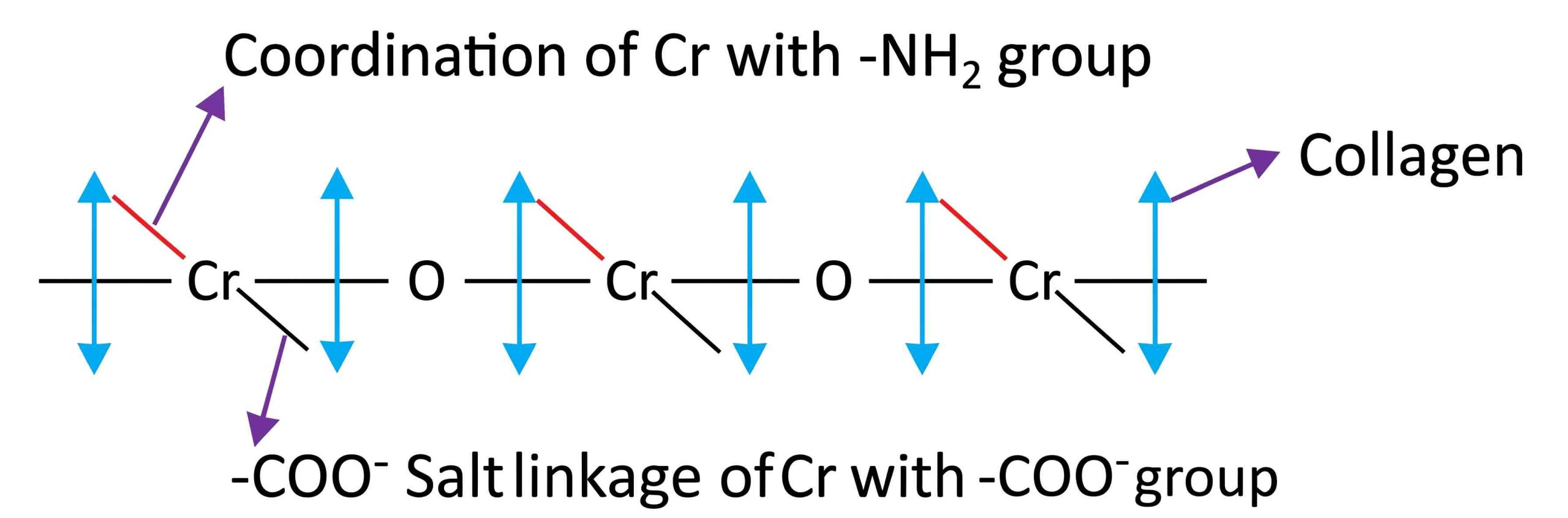
When pickled skin is soaked in a solution of basic chromium sulfate [Cr2(SO4)3] or chromic acid [H2Cr2O7], the two functional groups present within the collagen protein—the amino group (-NH2) and the carboxyl group (-COOH)—coordinate and bind with Cr to form a stable collagen-chromium complex compound.
Chromium establishes a strong bridge link between two adjacent protein chains. In this manner, numerous Cr complexes connect with one another via oxygen bridges to form extended polymeric networks. Consequently, this fills and cross-links the linkages previously exposed within the protein structures during the pickling stage.